


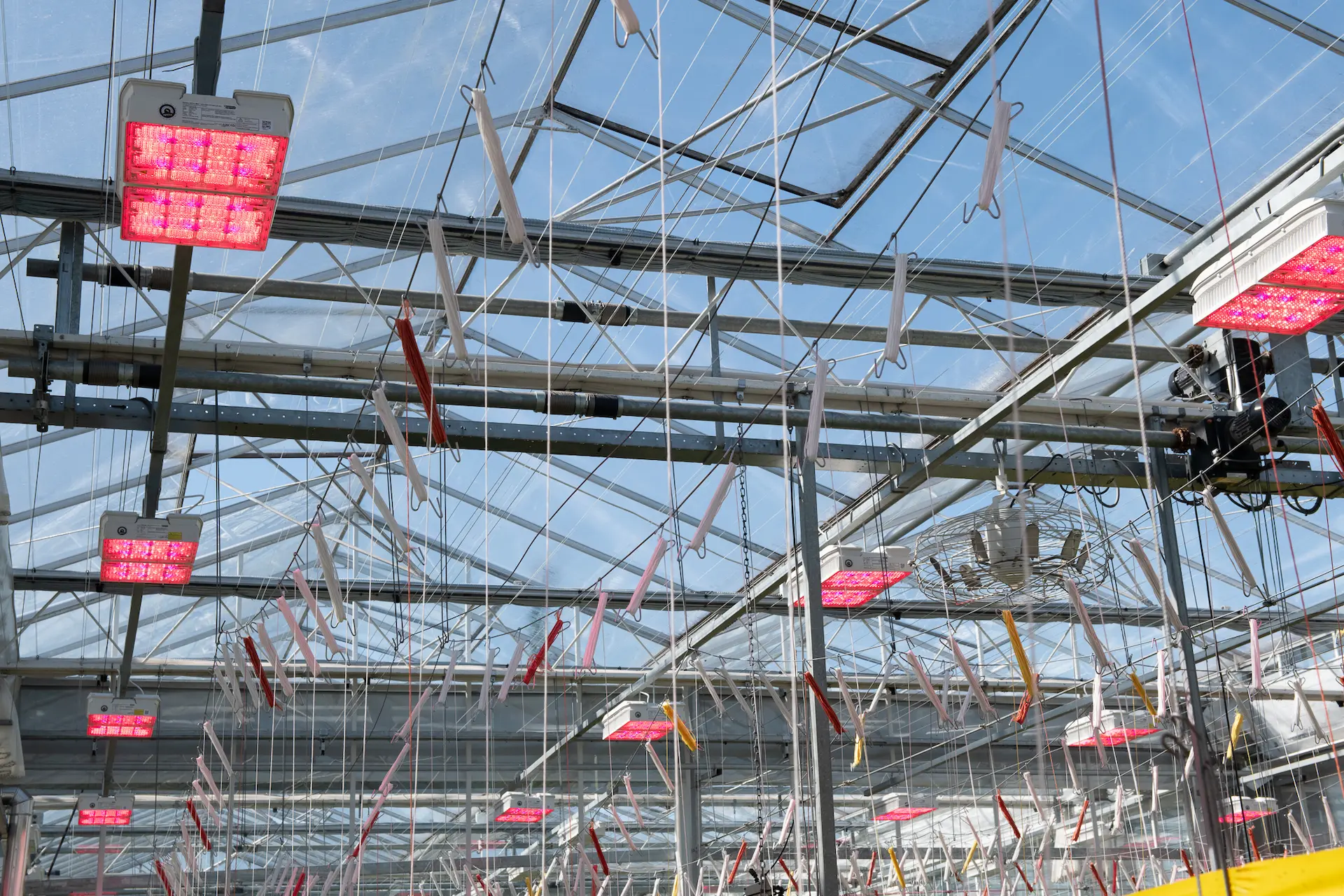
Growers improve light penetration in dense greenhouse crops by combining good crop management, well-placed lighting and regular measurement. Leaf removal, plant density and training system decide how much light reaches the lower canopy. Inter-lighting, fixture placement and spectrum can then add light where top lighting cannot reach. The right mix depends on your crop, cultivar, greenhouse and production goals.
The sections below explain what limits light in a dense canopy, which levers you can adjust, and how to check whether your changes work.
What causes poor light penetration in a dense canopy?
Poor light penetration is mainly caused by leaf overlap. Each layer of leaves absorbs and reflects light, so less reaches the layers below. A high leaf area index (LAI), which is the total leaf surface per square metre of floor, means more shading in a dense greenhouse crop.
Several other factors play a role. Large, horizontal leaves intercept more light than smaller, more upright ones. More stems per square metre increase mutual shading. A tall, mature tomato or cucumber crop shades its own lower leaves much more than a young crop does. Light from above is absorbed by the top leaves first, so little remains for the middle and bottom of the canopy. Diffuse light, for example from greenhouse glass or coatings, tends to reach deeper into a canopy than direct light, so your greenhouse construction and covering also matter.
Leaves deep in the canopy are not always unproductive. They still contribute to photosynthesis when they receive enough light. When they receive too little, they can become a net cost to the plant, because they use energy to stay alive without producing enough in return. This is why light distribution matters as much as the total amount of light.
How does crop management affect light penetration?
Crop management controls how much leaf area stands in the light path. Leaf removal, stem density, plant training and row spacing all influence how deep light can travel into the canopy. Good crop management may improve light penetration without any change to your lighting installation.
Leaf management
Removing old or heavily shaded leaves opens the canopy and can let light reach flowers, fruit and younger leaves. The balance is important. Removing too many leaves reduces the leaf area available to capture light, while removing too few leaves keeps the canopy closed. The right level depends on the crop, cultivar, growth stage and the amount of natural light at your location and in your season.
Plant density and training system
Training systems such as high-wire, V-shaped or leaning-row systems change how leaves are arranged in the crop. Stem density can also be adjusted through the seasons. A lower density in low-light periods may reduce mutual shading, while a higher density may suit periods with more light. Row orientation and spacing influence how light enters the crop, especially when you use inter-lighting.
Does inter-lighting improve light penetration better than top lighting?
Inter-lighting can bring light directly into the middle and lower canopy, which top lighting cannot do well in a dense crop. In most cases it does not replace top lighting. The two approaches complement each other, and the best combination depends on your crop, canopy structure and energy costs.
Top lighting covers the upper canopy and provides the main share of light in many greenhouse systems. Inter-lighting places luminaires inside or between plant rows, close to the leaves that would otherwise be shaded. It is widely used in tall vine crops such as tomatoes and cucumbers, where the canopy is deep. Low or open crops usually benefit less from it.
When you compare the two, think about the practical side as well. LED inter-lighting puts a heat source closer to the plant, so consider its effect on air movement, leaf temperature and humidity. It also adds installation work and has to fit your daily crop handling, such as leaf removal and harvesting. If you can dim top lighting and inter-lighting separately, you can adjust the light split as daylight, crop stage and energy prices change. There is no single answer that suits every grower, so a lighting plan based on your own greenhouse and crop gives a more reliable basis for the decision.
How do fixture placement and light distribution matter?
Fixture placement and light distribution decide how evenly light spreads across the crop. Uneven distribution creates bright and dark areas, so some plants receive too much light while others receive too little. Careful positioning of luminaires can improve uniformity and help you make better use of the light you apply.
Several design choices affect the result. Luminaires mounted higher spread light over a wider area, but the intensity at the crop drops, and greenhouse height often limits your options. The spacing between fixtures determines how much the light beams overlap and how even the light is at canopy level. The beam angle and optics of a luminaire influence how much light reaches the sides of the canopy and how much falls between the rows. Gutters, trusses and screens can cast shadows, and light levels often drop at the edge of a compartment, which may call for adjusted spacing.
It is also useful to separate PPFD from DLI here. PPFD is the number of photosynthetically active photons reaching a square metre each second, in µmol/m²/s. DLI is the total amount received over a day, in mol/m²/day. A layout can show a good average PPFD while individual positions still fall short, so check uniformity as well as the average.
Does light spectrum change how deeply light penetrates?
Light spectrum can affect how deeply light penetrates, because leaves absorb different wavelengths to different degrees. Blue and red light are absorbed strongly by the top leaves. Green and far-red light are absorbed less and can travel further into the canopy. Crop response varies, so spectrum is not a universal solution.
Leaves partly transmit and reflect green light. It can contribute to photosynthesis in lower leaf layers that receive little red or blue light. Far-red light passes through leaves more easily and influences plant shape and development. Its effects differ between crops, cultivars and growing conditions, so apply it with care and watch how the crop responds.
Keep two related concepts apart. Dimming changes light intensity, while dynamic spectrum control changes the wavelength composition of the light. Not every lighting and control system supports both. In a deep canopy, adding light in the right place often matters more than changing the spectrum alone, so consider spectrum together with intensity.
How can growers measure light penetration in the canopy?
You can measure light penetration by recording PPFD at several heights inside the canopy and comparing it with the level above the crop. A quantum sensor, also called a PAR sensor, gives these readings. The ratio between the lower and upper levels shows how much light the canopy lets through.
A practical approach looks like this:
- Measure above the canopy to set a reference PPFD.
- Measure at several depths, for example in the upper, middle and lower canopy.
- Repeat at multiple positions across the compartment, including between fixtures, under gutters and near edges.
- Take readings in comparable conditions. Daylight changes quickly, so measuring at night with only artificial light gives more consistent results.
- Compare over time as the crop develops and after you change leaf management or lighting.
PAR describes the wavelength range of photosynthetically active radiation (400 to 700 nm), while PPFD is the measured photon flux within that range. Handheld sensors give a snapshot. Fixed sensors and light measurement services support longer-term tracking, which helps you link light levels to crop performance.
How Agrolux helps with light penetration in dense crops
At Agrolux, we start with your crop, your greenhouse and your goals, and look at lighting as one part of the whole cultivation environment. Light penetration depends on your crop, cultivar, growth stage, greenhouse height, natural light, climate and energy prices, and our advice takes these into account.
Where relevant, we can support you with greenhouse-specific lighting plans that consider canopy structure, fixture placement and light distribution, and with light measurements that show how light reaches different parts of your canopy. Our agronomists and plant scientists can advise on how light and spectrum may affect your crop. We also offer LED and HPS lighting solutions, with attention to heat distribution, air circulation and greenhouse climate, and dynamic lighting and energy management that adjusts intensity to available sunlight, energy prices and crop requirements. Our modular LYRA™ platform can be expanded or modified as your needs change.
If you want to improve light penetration in your own crop, we are glad to talk through your situation. Visit the Agrolux homepage to get in touch with our specialists, or view our project portfolio to see how we work with growers.
Related Articles
- What happens when greenhouse crops receive too much light?
- What happens when greenhouse crops receive too little light?
- How does greenhouse lighting affect total cost of ownership?
- How can greenhouse growers compare the efficiency of different lighting systems?
- What is photon efficacy and why does it matter for greenhouse lighting?