


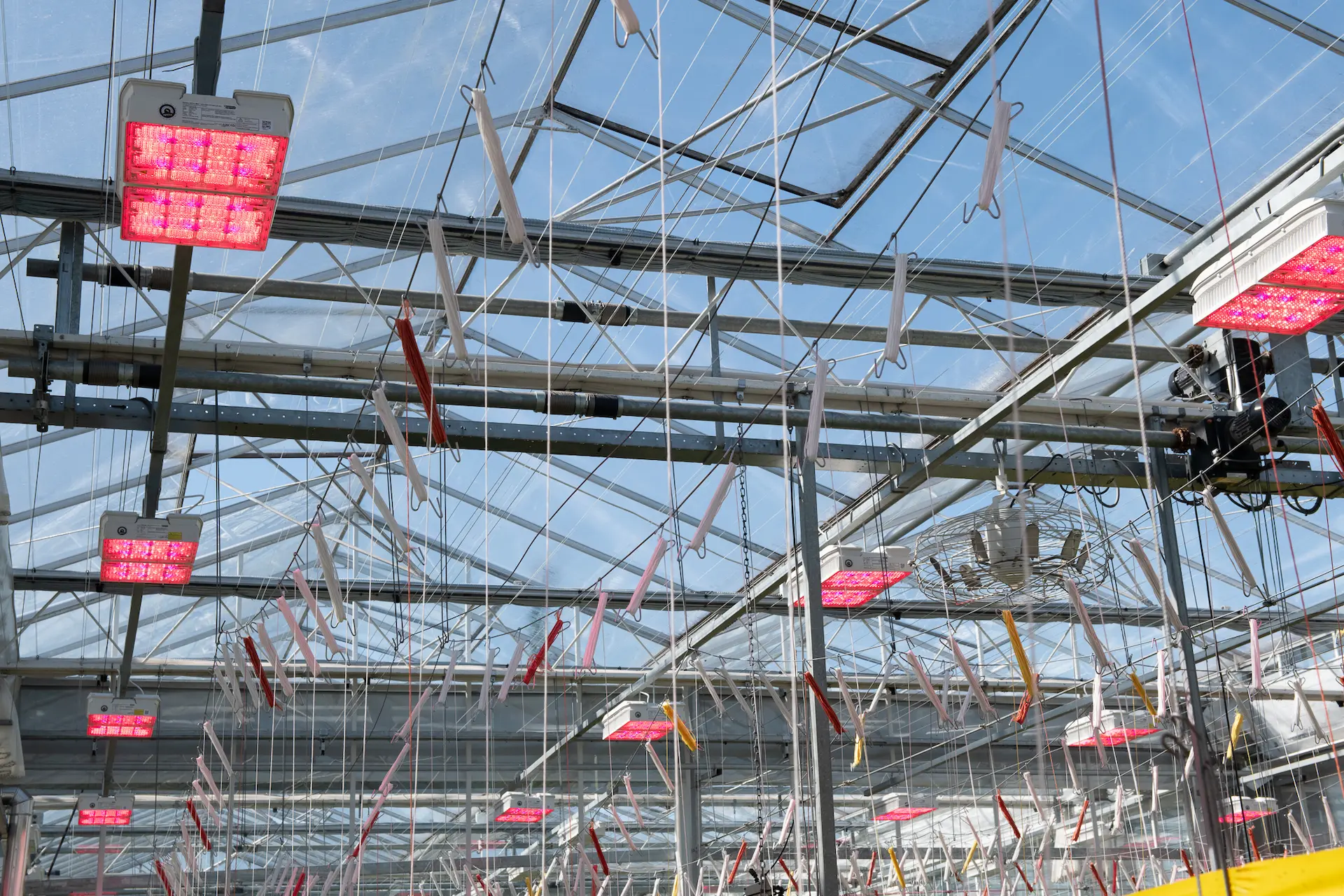
When greenhouse crops receive more light than they can use, the extra energy can damage the photosystems in the leaves. This may bleach the leaf, slow growth and lower crop quality. The problem can come from high light intensity (PPFD), a high total daily light dose (DLI), or both. The level at which damage starts depends on the crop, the cultivar and the growth stage. This article explains how light damage develops, how to recognise it, which crops are most sensitive and how to manage supplemental lighting.
Why does excess light damage plant tissue?
Excess light damages plant tissue because leaves absorb more light energy than they can use for photosynthesis. The unused energy forms reactive oxygen species, which can harm chloroplasts, cell membranes and pigments. This process is called photoinhibition, and it reduces the leaf’s ability to photosynthesise.
Every leaf has a light saturation point. Above this point, more light no longer increases photosynthesis. Plants have some protection, such as releasing excess energy as heat and producing protective pigments. When the light load is higher than these defences can handle, the tissue starts to suffer.
Heat makes the problem worse. Leaves in strong light warm up, especially when air movement is poor or the crop transpires little. The stomata may close to save water, which limits CO₂ uptake and leaves the leaf with even less capacity to use the light. This is why light damage often appears during bright periods combined with dry or hot greenhouse conditions.
What are the visible signs of light stress in crops?
The most common signs of light stress are pale or bleached leaves, scorched patches, curled or cupped leaves and slow growth. Early symptoms can be subtle. Several other problems cause similar symptoms, so compare what you see with light measurements and climate data before you draw conclusions.
Typical symptoms include:
- Leaf burn: dry, brown or white patches, usually on the upper leaves closest to the lamps or the glass.
- Bleaching or yellowing: chlorophyll breaks down and the leaves turn pale or washed out.
- Leaf curling or cupping: leaves fold or roll, which reduces the surface exposed to light.
- Tipburn: brown edges on young leaves. High light can speed up growth while calcium transport falls behind, although climate, irrigation and nutrition also play a role.
- Compact, hardened growth: short internodes and thick, leathery leaves can point to a high light load.
- Poor growth despite high light: a lower growth rate, flower or fruit problems and reduced quality can show that the crop cannot use all the light it receives.
Symptoms rarely have a single cause. Nutrient imbalances, root zone problems, disease and low humidity can look similar. Check the pattern across the greenhouse. Damage concentrated directly under certain luminaires or in sunny zones suggests that light is a likely cause.
Which greenhouse crops are most sensitive to high light?
Shade-adapted crops, such as many potted plants, orchids and some leafy greens, are generally the most sensitive to high light. Fruiting crops such as tomatoes and cucumbers usually tolerate more light and make better use of it. Sensitivity still varies with the cultivar, the growth stage and how well the crop has acclimatised.
- Shade-adapted ornamentals and potted plants: often reach saturation at lower light levels and can scorch quickly in strong light.
- Lettuce and other leafy greens: tipburn is a recurring risk, especially in fast-growing crops under high light.
- Young plants and propagation material: seedlings and cuttings have small root systems and need careful light management while they establish.
- Soft fruits such as strawberries: the light response depends on the cultivar and the cultivation system, and research on spectrum for strawberries is still developing.
- Tomatoes and cucumbers: these crops can use a lot of light, but they still show stress when light intensity, climate or nutrition are out of balance.
Acclimation matters. A crop grown under low light for several weeks can suffer when conditions change suddenly, for example after a bright spell or when supplemental light is increased. Gradual changes give the plants time to adapt.
How much light is too much for a crop?
A crop receives too much light when extra intensity or a higher daily dose no longer improves growth and signs of stress or quality loss appear. No single number applies to every crop. The limit depends on the crop, the cultivar, the growth stage, CO₂ level, temperature, humidity and the natural daylight already present.
Two measures help you understand this:
- PPFD (Photosynthetic Photon Flux Density) is the number of photosynthetically active photons that reach one square metre each second, measured in µmol/m²/s. It describes light intensity at a given moment.
- DLI (Daily Light Integral) is the total amount of photosynthetically active light received over 24 hours, measured in mol/m²/day. It describes the total daily dose.
The two can tell different stories. A crop may cope with a high DLI spread over a long photoperiod but struggle with a short, intense peak. In a greenhouse, you must also count sunlight. A DLI target should include natural light plus supplemental light, not lamp output alone.
For this reason, rely on measurements and crop observation rather than general figures. Targets from your plant supplier, your own experience and trial data for your cultivar give better guidance than a single benchmark. Keep in mind that the crop’s photoperiod limits how you can spread the light. You cannot simply compress the dose into fewer hours.
How can growers prevent light stress with supplemental lighting?
You can prevent light stress by matching supplemental light to the needs of the crop and to the daylight available at any moment. In practice, this means measuring light, setting DLI and photoperiod targets, dimming when sunlight is strong and making changes gradually. Good light management also takes the greenhouse climate and the crop stage into account.
Practical steps include:
- Measure first. Check PPFD and how evenly the light is spread over the crop. Hot spots under luminaires can cause local damage even when the average looks acceptable.
- Set targets per crop and stage. Define a DLI range and photoperiod for each crop, cultivar and growth stage, and review them as the season changes.
- Account for daylight. Dimming lets supplemental light follow natural radiation instead of adding to it. Radiation forecasts and sensors help the system respond in time. Dimming changes intensity, while dynamic spectrum control changes the colour composition of the light. These are different functions, and not every control system supports both.
- Manage the climate. Air circulation, humidity and temperature affect how leaves cope with light. HPS and LED lamps release heat differently, so the greenhouse climate may respond differently after a change of lighting technology.
- Change gradually. Raise intensity in steps so the crop can acclimatise.
- Check the whole system. Irrigation, nutrition (including calcium supply) and CO₂ all influence how much light a crop can use.
- Observe regularly. Walk the crop and record early symptoms in each zone.
Energy prices are another factor. Dimming in response to sunlight and electricity cost can help avoid unnecessary lighting and reduce energy use, depending on your installation, control strategy and crop requirements.
How Agrolux can support your light management
The right lighting approach starts with the crop and your growing strategy. It also depends on your location, natural light, greenhouse construction and height, existing technology, energy prices and climate. At Agrolux, we work with growers to look at these factors together and find a lighting strategy that fits their situation.
Our support can include:
- Greenhouse-specific lighting plans that take the crop, growth stage and daylight conditions into account.
- Light measurements that show intensity and distribution, which can help you find hot spots and uneven light.
- Agronomic advice from our agronomists and plant scientists on how light and spectrum may affect your crop.
- LED and HPS expertise, including how each technology affects heat distribution and greenhouse climate.
- Dynamic lighting and energy management through compatible luminaires, software and wireless connectivity, so intensity can follow sunlight, energy prices and crop requirements.
- Modular technology such as our LYRA platform, which you can modify or expand as your requirements change.
If you would like to review light levels, DLI targets or stress symptoms in your crop, we are happy to talk. Visit the Agrolux homepage to contact our specialists, or browse our portfolio to see how we work with growers.
Related Articles
- How does the timing of supplemental lighting affect plant growth?
- How does light quality influence greenhouse crop development?
- What Is PPFD and What Does It Tell You About Greenhouse Lighting?
- What is photon efficacy and why does it matter for greenhouse lighting?
- How does greenhouse lighting interact with heating and ventilation?