


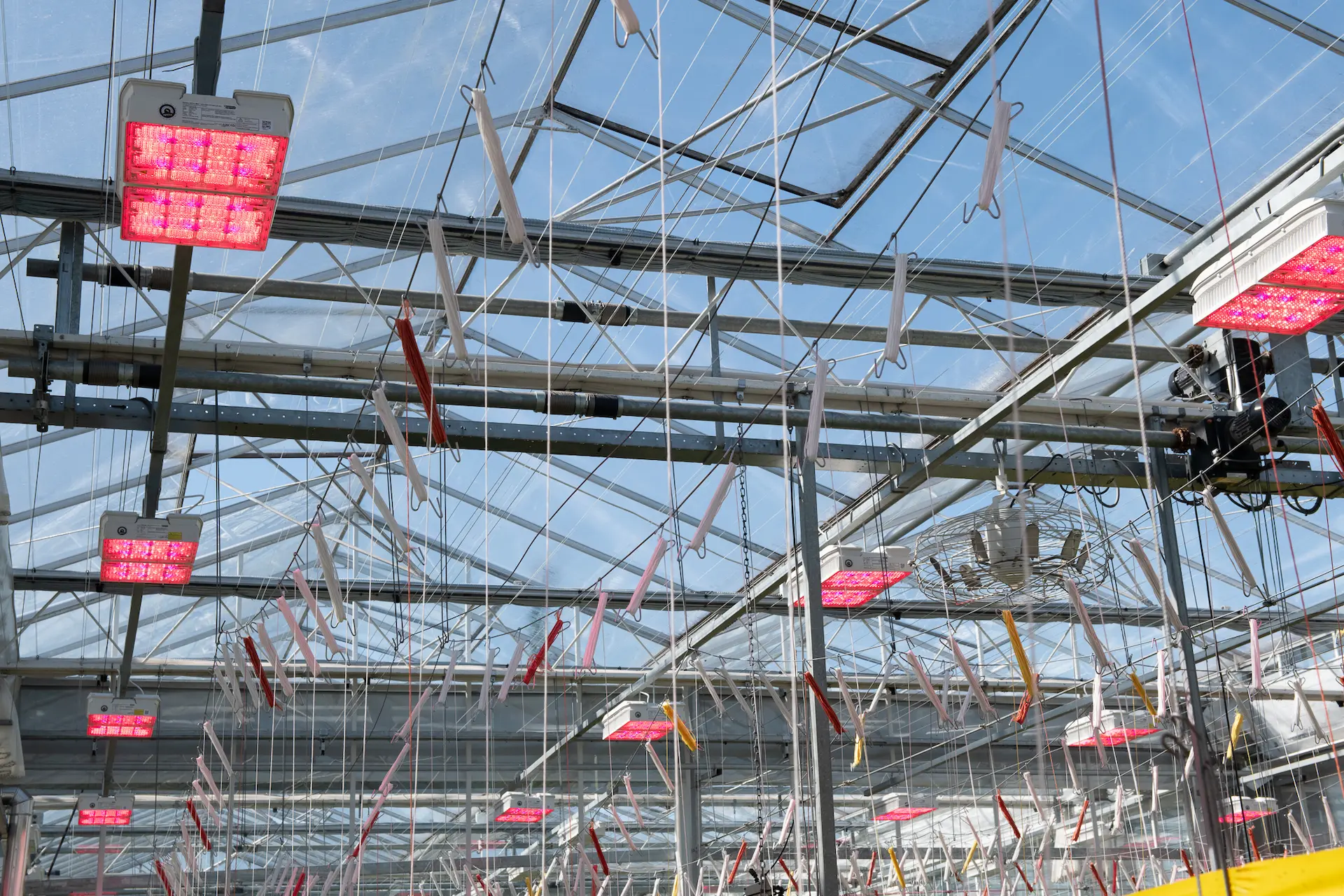
Start with your crop. Work out how much light it needs each day, measure how much daylight you actually get, and add only the light that is missing. Controls that dim the lamps as daylight changes help keep the light level steady and avoid wasting energy. The right balance depends on your crop, variety, growth stage, location, season, greenhouse structure and energy prices.
The sections below cover how much supplemental light a crop may need, how to adjust as daylight changes, how LED and HPS compare, how lighting affects climate and energy use, which mistakes to avoid, and which tools can help you refine your approach.
How much supplemental light does a crop need?
A crop needs enough supplemental light to reach its target daily light integral (DLI) after natural daylight has contributed. DLI is the total amount of light the crop can use for photosynthesis over 24 hours, measured in mol/m²/day. The target depends on the crop, variety, growth stage and your production goals, so no single number fits every greenhouse.
Two measurements are often confused. PPFD (photosynthetic photon flux density) is the light intensity reaching one square metre at a given moment, measured in µmol/m²/s. DLI is the total of that intensity over the whole day. A lower PPFD for more hours can give the same DLI as a higher PPFD for fewer hours, but the crop may not respond in the same way.
The gap you need to fill depends on your crop and variety, because a tomato crop, a leafy green and a potted plant use light differently. It also depends on the growth stage, since propagation, vegetative growth and fruit load all change light demand. Location and season matter too: greenhouses in northern Europe and North America see very different winter daylight. Finally, the greenhouse itself reduces light, through roof materials, height, shading screens and structure.
Photoperiod, or day length, also matters. Many crops need a minimum dark period or respond to day length, so you cannot freely move light into different hours without considering how the crop grows. Start with what your crop needs, then work out what daylight leaves unmet.
How do growers adjust lighting as daylight changes?
Growers adjust lighting by dimming or switching lamps in response to measured daylight, so the total light stays close to the crop’s target. When clouds pass or the seasons change, the system raises or lowers the artificial light to fill the gap. Dimming changes light intensity only. It does not change the spectrum.
Adjustment happens over different timescales. Within the day, sensors measure incoming light and the lamps dim up or down to keep the combined light on target. Across days, you can track the accumulated DLI, so a bright morning reduces the light needed later. Across seasons, lighting hours and intensity change as short winter days give way to stronger spring light.
Radiation forecasts add a planning layer. If a bright day is expected, you can plan to supply less light. Electricity prices can be another input, since you may prefer to give more light in cheaper hours, as long as the photoperiod and crop requirements still allow it.
Not every control system supports every function. Some offer simple on/off switching, others stepped dimming, and others continuous dimming linked to sensors. Check what your lamps and controller can do before you build a strategy around a specific feature.
Should growers use LED or HPS for supplementation?
Neither LED nor HPS is the better choice for every greenhouse. LED offers high photon efficacy and flexible dimming, while HPS gives off radiant heat that some crops and climates can use. The right choice depends on your crop, climate, energy price, existing installation and investment plans.
Look at more than electricity use when you compare the two. Photon efficacy tells you how much light each unit of electricity produces. Light distribution shows how evenly the light reaches the crop. Spectrum matters because each technology delivers different wavelengths, and crops respond differently. Upfront cost, lifetime and servicing needs also differ.
Heat deserves particular attention. HPS lamps give off significant radiant heat, which can warm the crop and may reduce heating demand in cold periods. LED lamps give off less radiant heat toward the crop, which can change leaf temperature, transpiration and air movement. Growers are still gaining experience with cultivation under LED compared with HPS, so climate settings often need adjusting after a switch.
Some growers combine both technologies, or add LED to an existing HPS installation in stages. A modular approach lets you adapt as energy markets and cultivation needs change.
How does supplemental lighting affect greenhouse climate and energy use?
Supplemental lighting changes the greenhouse climate because every lamp adds light and some heat, which affects temperature, humidity and plant transpiration. It also becomes a large share of energy use. Treating lighting as part of the whole growing environment helps you manage both climate and energy costs.
Light, heat and humidity interact. More light increases photosynthesis and transpiration, which changes how much moisture the crop releases. Your heating, ventilation and screen settings may need to follow. When you change lighting technology or intensity, review your climate strategy at the same time.
On the energy side, several measures can help reduce consumption, depending on conditions. You can dim lamps when daylight already supplies enough light, and avoid lighting when extra light adds little benefit for the crop. Where the photoperiod and crop requirements allow, you can also shift lighting toward lower-price hours. When you compare options, consider the total cost of ownership, which includes investment, energy, maintenance and expected lifetime, not only the purchase price.
Results vary with your installation, control strategy, crop and local electricity prices. Measure your actual consumption and compare it with crop response before you draw conclusions.
What mistakes make daylight and artificial light work against each other?
The most common mistakes are lighting without measuring daylight, ignoring the accumulated DLI, and running fixed schedules that do not follow the weather. These errors can waste energy or leave the crop short of light. Most come from treating supplemental light as a separate system instead of a partner to daylight.
Without a light sensor, you cannot tell how much supplementation is needed. Lamps running at full output on bright days waste electricity. A high instantaneous reading does not guarantee the daily total you need, which is why PPFD and DLI should not be mixed up. Shortening or extending light hours without considering how the crop grows can affect development. Uneven light creates differences across the canopy that averages can hide. Switching lighting technology without revisiting temperature and humidity settings is another common oversight. Dirty roofs, screens and lamps also reduce the light you think you have.
Copying another grower’s setup is a further trap. Their crop, location and greenhouse differ from yours, so your lighting plan should reflect your own conditions.
What tools help growers fine-tune light strategy over time?
Light sensors, controllers, lighting plans and agronomic advice can all help you refine your strategy over time. Sensors show what the crop receives, controllers apply your strategy automatically, and regular review connects light data to crop results. Together they help you improve your decisions each season instead of relying on assumptions.
Light sensors measure incoming daylight and light at crop level, which supports dimming and DLI tracking. Lighting control software applies dimming, schedules and zones, and can link to radiation forecasts and energy prices where supported. On-site light measurements show how light is distributed across the canopy. A lighting plan models how a given setup would perform in your specific greenhouse before you commit. Agronomic advice connects light levels to crop development, variety response and your cultivation goals.
Wireless connectivity can make it easier to control many lamps from one place and to expand a system later. Whatever you choose, record your light data alongside crop results so you can see what works and adjust accordingly.
How Agrolux helps with balancing daylight and supplemental lighting
At Agrolux, we see greenhouse lighting as a plan built around your crop and your conditions, not a product-selection exercise. The right solution depends on your location, available daylight, greenhouse construction and height, crop, cultivation stage, existing technology and energy prices. We combine lighting technology with agronomic knowledge to help you make informed decisions.
Where relevant to your situation, we can support you with greenhouse-specific lighting plans and light measurements that show how light is distributed in your greenhouse. We offer LED and HPS lighting solutions, with honest advice on which fits your situation. Our agronomists and plant scientists can explain how light and spectrum may affect your crop. For growers who want dynamic control, our LYRA platform is modular and can be expanded or modified as requirements change, and AgroluxOS with wireless connectivity supports centralised control that adjusts light intensity based on daylight, energy prices and crop requirements.
Want to discuss your crop, greenhouse and lighting strategy? Visit our Agrolux homepage to contact our specialists, or look through our project portfolio to see how we approach different greenhouse situations.
Gerelateerde artikelen
- How does the timing of supplemental lighting affect plant growth?
- What is light-sum control in greenhouse lighting?
- What is the difference between measuring light above and within the crop canopy?
- Hoe helpt dynamische verlichting kasbouwers bij het beheersen van hun energieverbruik?
- Hoe kunnen kasbouwers het maximale uit hun belichtingsstrategie halen?