


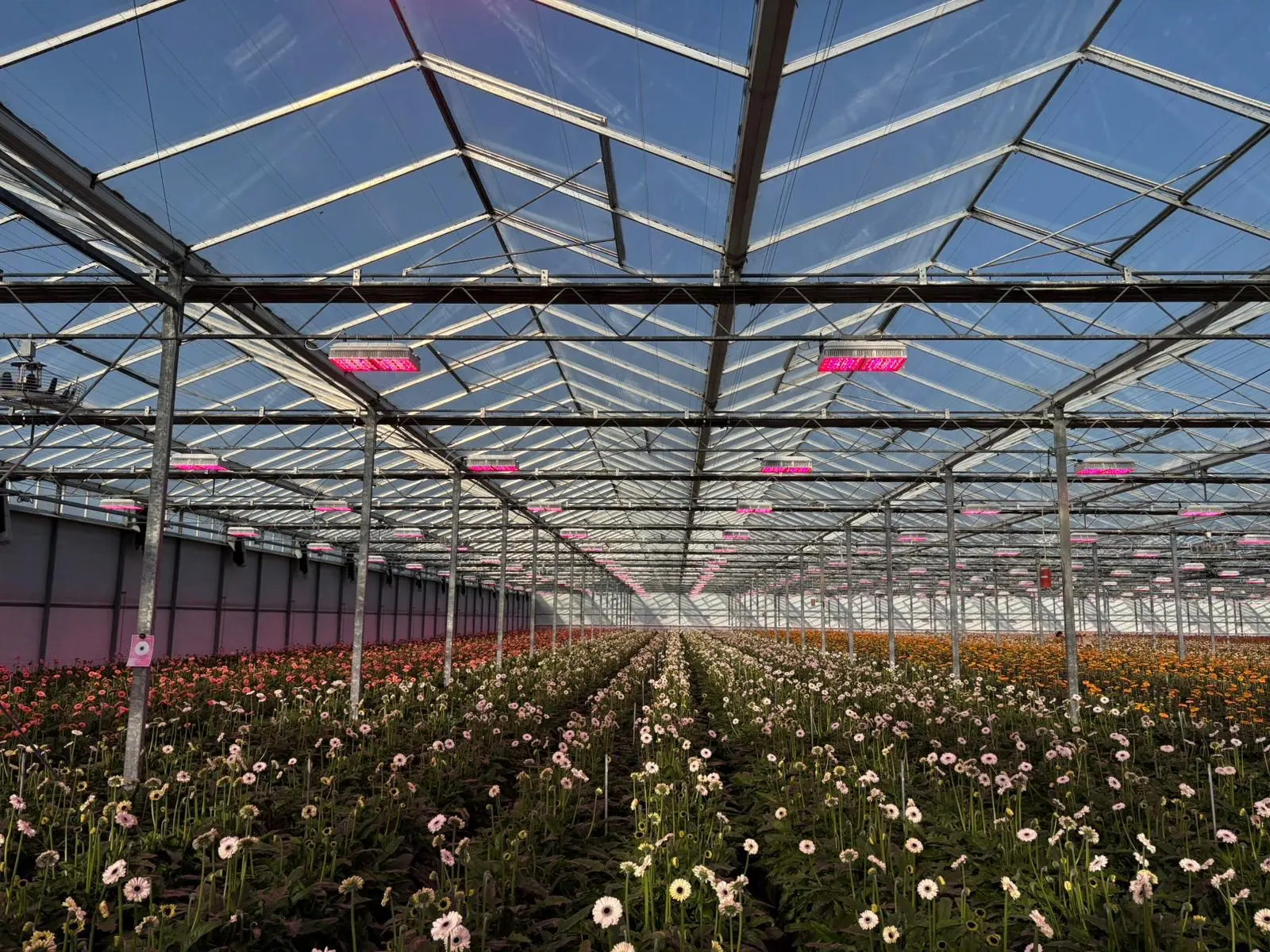
Greenhouse growers get the most out of their lighting strategy by choosing the right light source technology for a uniform light distribution, matching the spectrum, light intensity and duration to crop needs, and using intelligent controls to manage energy use efficiently. The foundation is understanding your crop’s daily light integral (DLI) requirements and building a supplemental lighting plan around them. The questions below address each of these factors in practical detail.
What factors determine how much light your greenhouse crops actually need?
The amount of supplemental light your crops need depends on the natural light available at your location, the time of year, and the target DLI for your specific crop and growth stage. The DLI (daily light integral) is the total amount of photosynthetically active radiation received by a crop over a 24-hour period, expressed in mol/m²/day. Getting the DLI target right is the starting point for any effective greenhouse lighting strategy. It is also important to take the light saturation point into account, especially during the high-light season or in locations with high natural light levels.
Different crops have very different DLI requirements. Tomatoes and cucumbers generally require a relatively high DLI and typically perform well at 20 to 30 mol/m²/day, although higher values can further support growth and yield when other growing conditions are optimized. Leafy greens may only need 12 to 17 mol/m²/day. Soft fruits and cut flowers often fall somewhere in between, depending on the variety and growth stage. During propagation, light requirements are generally lower, and plants are more sensitive to excessive light intensity.
Your geographic location also plays a significant role. Growers in Northern Europe or Canada face long periods of low natural light during winter, meaning supplemental lighting carries a much larger share of the total DLI. Growers in sunnier climates may use supplemental lighting mainly for daylength extension or during overcast periods.
By predicting and monitoring outdoor radiation, growers can supplement only the light that is actually missing, rather than operating their lighting system according to fixed schedules. This approach helps maintain target DLI levels while optimizing energy consumption.
How does light uniformity affect crop quality and yield?
Light uniformity directly affects how evenly crops develop across a greenhouse bay. When some plants receive significantly more light than others, you get uneven growth rates, inconsistent product quality, and higher labor costs at harvest. In commercial greenhouse production, uniformity is not just a performance metric, it affects the commercial value of your entire crop.
A common measure of light uniformity is the ratio between the minimum and average light levels across the growing area. A ratio above 0.7 is generally considered acceptable for professional greenhouse production, though higher is better. Light uniformity can be compromised when fixtures are spaced incorrectly, installed too close to the crop, or when the light distribution pattern does not match the greenhouse design.
Achieving good uniformity requires careful photometric planning before installation. This means modeling the light distribution of your chosen luminaires in your specific greenhouse structure, accounting for bay width, gutter height, reflective surfaces, and crop canopy height. Adjusting fixture spacing and mounting height can significantly improve the uniformity of light distribution throughout the greenhouse.
What’s the difference between HPS and LED lighting for professional greenhouses?
HPS (high-pressure sodium) and LED are the two main technologies used in professional greenhouse supplemental lighting. The main differences lie in energy efficiency, spectrum flexibility, heat output, yearly maintenance, and upfront cost. LED fixtures convert a higher percentage of electrical energy into usable light and generate less radiant heat, while HPS fixtures are less efficient but have lower purchase costs and a well-established track record in commercial production.
HPS lighting: strengths and limitations
HPS has been the standard in professional greenhouse lighting for decades. It produces a broad spectrum with a strong emphasis on red and yellow wavelengths, which supports photosynthesis effectively. HPS fixtures are robust, relatively inexpensive to purchase, and many growers have extensive practical experience with them. The main drawback is energy efficiency: HPS converts a lower proportion of electricity into useful wavelengths for photosynthesis compared to modern LED alternatives. The significant heat output from HPS can be an advantage in cold climates where it contributes to greenhouse heating, but in warmer conditions it adds to cooling costs.
LED lighting: strengths and limitations
LED fixtures for professional horticulture have advanced considerably and now convert a much larger proportion of electricity into useful wavelengths for photosynthesis. Modern horticultural LEDs outperform HPS in this regard, which translates directly into lower electricity consumption for the same light output. LEDs are also dimmable, and allow spectrum customization, enabling growers to adjust the ratio of red, blue, and far-red light to influence plant morphology, flowering, and secondary metabolite production. The higher upfront investment is the primary barrier, though energy savings over the fixture’s lifespan usually offset this over time.
How can intelligent controls improve lighting efficiency in a greenhouse?
Intelligent lighting control improves greenhouse lighting efficiency by automatically adjusting light output based on real-time natural light levels, energy prices, and crop DLI targets. Instead of running lights on fixed timers, a control system continuously calculates how much supplemental light is needed and dims or switches fixtures accordingly, reducing energy use without compromising crop performance.
The most practical benefit is light-sum control, where the system tracks cumulative DLI throughout the day and adjusts supplemental lighting to reach the target without overshooting. By combining real-time light measurements with weather and radiation forecasts, the system can predict how much natural light is expected later in the day and adjust lighting levels accordingly. At the same time, the required photoperiod is respected to ensure consistent crop development and flowering responses where applicable. On bright days, lights may run at reduced output or not at all. On overcast days, they compensate fully. This dynamic approach uses energy only when it delivers genuine agronomic value.
In addition to optimizing the daily light sum, modern lighting control systems can help reduce energy costs by making smart use of available electricity. When electricity prices vary throughout the day, the system can increase lighting during lower-cost periods and reduce it when prices are higher, while still meeting the crop’s lighting requirements. If renewable energy is available on-site, the system can also make use of that energy whenever possible. Many routine lighting adjustments can be handled automatically, reducing the need for day-to-day adjustments while allowing growers to intervene if necessary.
When should greenhouse growers switch from HPS to LED?
Greenhouse growers should consider switching from HPS to LED when they are replacing aging fixtures, expanding their growing area, facing rising energy costs, or when their crop would benefit from spectrum flexibility. The decision is not simply about technology preference, it depends on your current infrastructure, energy tariffs, climate, and the financial return you can realistically expect from reduced electricity consumption.
A practical starting point is calculating your current cost per mol of light delivered to the crop. If your HPS fixtures are aging and efficiency has declined, or if electricity prices in your region have increased significantly, the payback period on LED investment shortens. However, energy savings are only part of the equation. Higher light levels, a more consistent daily light sum, and stable photoperiods can improve yields, product quality, and production consistency, creating value beyond energy savings alone. In 2026, LED technology continues to improve while hardware costs have come down compared to earlier generations, making the business case stronger than it was even a few years ago.
A full replacement is not always the right answer. Some growers adopt a hybrid approach, retaining HPS as a base layer for both heat and light output in winter while adding LED for top-lighting or inter-lighting in high-wire crops. This allows you to spread capital investment while still improving overall system efficiency. The right moment to switch is when the numbers support it for your specific operation, not because LED is newer, but because it delivers better returns under your conditions.
How Agrolux Helps With Your Greenhouse Lighting Strategy
We work with professional greenhouse growers to develop lighting strategies that are grounded in crop requirements, energy economics, and long-term operational flexibility. Rather than recommending a single product, we take the time to understand your greenhouse structure, crop(s), climate, and goals before proposing a solution.
- Photometric planning: We model light distribution in your specific greenhouse to optimize uniformity and avoid over- or under-lighting.
- DLI-based strategy development: We help you define realistic DLI targets for each crop and growth stage, and build a supplemental lighting plan around this.
- HPS and LED expertise: We offer both technologies and help you evaluate which approach, or which combination, makes sense for your operation.
- Intelligent control integration: Through AgroluxOS and HortiMesh™, we connect lighting to real-time data so your system responds dynamically to natural light and energy conditions.
- Scalable, modular solutions: Our systems are designed to grow with your operation, so you are not locked into a fixed configuration as your needs evolve.
If you want to discuss your specific greenhouse, crop requirements, or current lighting setup with our specialists, visit the Agrolux website or explore our lighting portfolio to see how our solutions are applied in practice. We are happy to work through the details with you.