


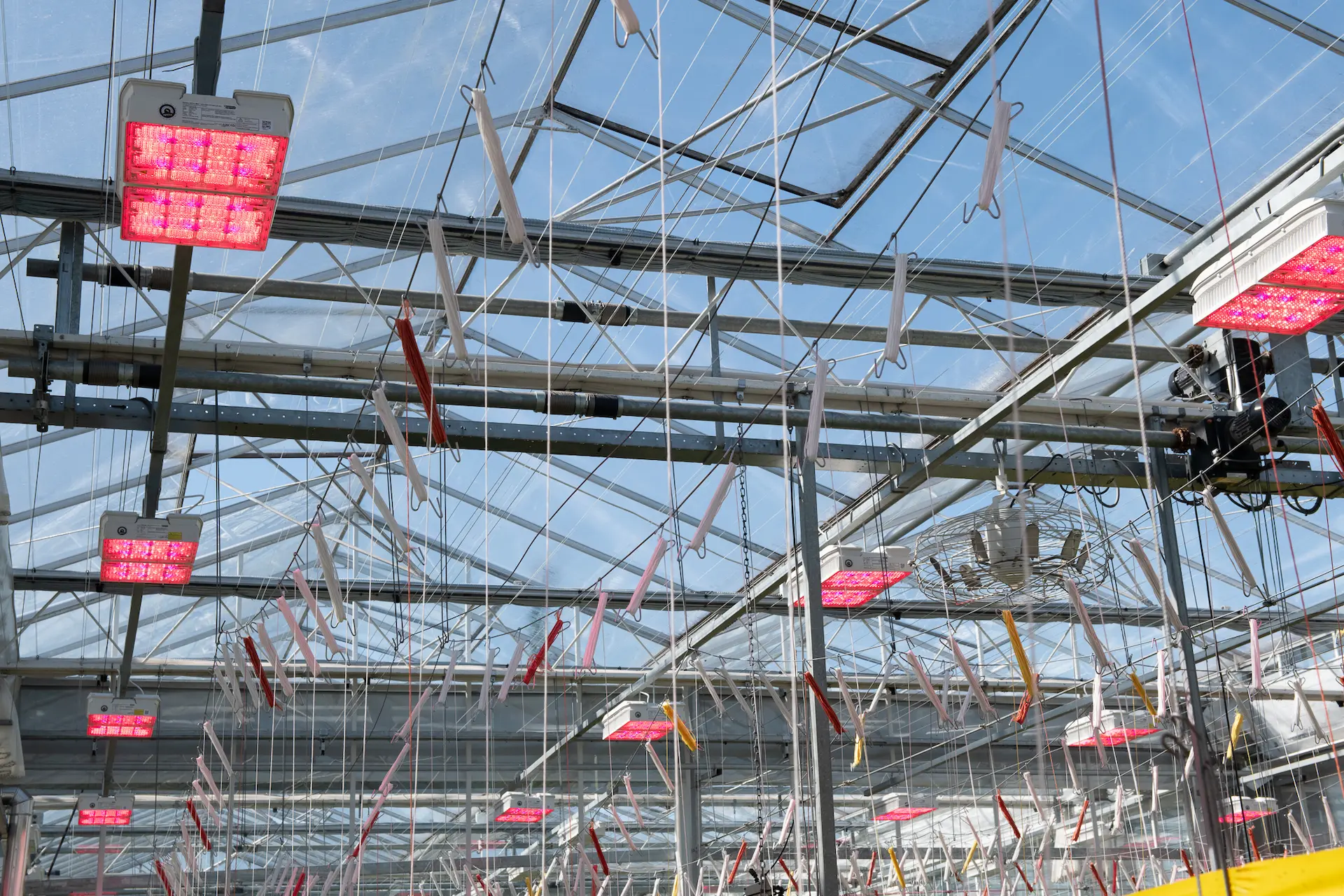
Light-sum control is a way of managing supplemental greenhouse lighting by aiming for a set amount of light per day, instead of running lamps on a fixed schedule. The system measures the daylight that reaches the crop, works out how much light is still missing from the daily target, and switches or dims the lamps to make up the difference. It always works within the crop’s photoperiod limits. This article explains how the calculation works, how it differs from fixed lighting, how to think about targets, and which equipment and common mistakes to consider.
How does light-sum control calculate supplemental light needs?
Light-sum control subtracts the light the crop has already received from the daily target. A sensor measures incoming sunlight, the controller adds it up over the day, and the lamps deliver the remaining amount, within the crop’s photoperiod and the capacity of the installation.
The target is expressed as a DLI (Daily Light Integral): the total amount of light the crop can use for photosynthesis over 24 hours, measured in mol/m²/day. This is different from PPFD (Photosynthetic Photon Flux Density), which is the light intensity reaching one square metre every second, measured in µmol/m²/s. PPFD tells you how strong the light is right now. DLI tells you how much light the crop has collected in total.
The controller works with three inputs. A light sensor above the crop or outside the greenhouse records the light that actually arrives, after losses from glass, screens and greenhouse structure. The controller also knows how much PPFD the lamps add at crop level at each dimming level. Finally, it uses the daily target, which you set for your crop and growth stage. Some systems also use radiation forecasts to plan the remaining hours of the day. Not every control system supports every function, so check which inputs your controller can use.
How is light-sum control different from fixed photoperiod lighting?
Fixed photoperiod lighting switches lamps on and off at set times, whatever the weather. Light-sum control switches them according to how much light the crop has accumulated. On bright days the lamps run less. On dull days they run longer or at higher intensity until the daily target is reached.
A fixed schedule is simple, but the crop receives very different amounts of light from day to day. A sunny day with lamps on all night delivers far more light than needed, while a dark winter day with the same schedule may fall short. Light-sum control reduces this variation, which may help keep growing conditions more consistent.
Photoperiod still matters. Many crops need a minimum dark period, and some are sensitive to daylength for flowering or development. You cannot freely move light around the 24 hours without considering these needs, so light-sum control should work inside defined start and stop windows.
| Aspect | Fixed photoperiod | Light-sum control |
|---|---|---|
| Switching logic | Clock times | Accumulated DLI versus target |
| Response to weather | None | Adjusts to measured daylight |
| Daily light consistency | Varies with weather | More stable, within lamp capacity |
| Setup effort | Low | Higher: sensors, targets, limits |
What light-sum target should growers set per crop?
The right target depends on the crop, the cultivar, the growth stage, the season and your production goals. No single value suits every grower. Start from what your crop needs and from your own experience, then refine the target using your results and advice from an agronomist.
Crops respond differently to light. Tomatoes, cucumbers, strawberries, leafy greens and ornamentals all have their own needs, and cultivars within a crop can differ too. The growth stage matters as well, because propagation, vegetative growth and fruit load place different demands on the plant. Location and season decide how much of the target the sun supplies for free.
The greenhouse climate also plays a role. Temperature, humidity and CO₂ need to support the light level, or the crop may not use the extra light well. Energy price is the last factor to weigh: a higher target costs more to reach, so it is worth asking whether the last mol of light still pays off. Treat the target as a setting you review, not a number you set once, and adjust it as the crop develops and conditions change through the season.
How does light-sum control reduce greenhouse energy costs?
Light-sum control can reduce energy costs by preventing over-lighting. Lamps stop or dim once the target is reached, so you pay for the light the crop still needs rather than light it already received from the sun. Savings depend on your installation, crop, climate and energy prices.
The system counts every mol of sunlight, so lamps are likely to run less on bright days. With dimmable luminaires, the controller can lower the intensity instead of switching fully on or off, which fits the output more closely to what is missing. Where the controller supports it, light can also be shifted to lower-price hours, as long as the photoperiod and the crop’s biological needs are respected. Finally, light above what the crop can use, for example when temperature or CO₂ is limiting, adds cost without benefit, and light-sum control helps avoid it.
Dimming is different from dynamic spectrum control. Dimming changes light intensity, while dynamic spectrum control changes the colour composition of the light. Light-sum control relies on dimming, and spectrum control is a separate subject.
Results vary. Energy use also depends on the heat that lamps add to the greenhouse, which interacts with your heating and ventilation, particularly when comparing HPS with LED.
What equipment is needed to run light-sum control?
Light-sum control needs a PAR light sensor, a controller that can accumulate light and switch or dim lamps, and luminaires that can be controlled. The system should preferably also connect with your climate computer, so lighting and climate decisions work together.
- Light sensors: accurate, well-placed and regularly cleaned sensors measure the daylight that reaches the crop. Some growers use both an outside and an inside sensor.
- Controller or software: this logs accumulated light, compares it with the target and applies your photoperiod limits and any price settings.
- Controllable luminaires: dimmable LED or HPS lighting lets the controller adjust output. Fixed on/off lamps allow only switching.
- Communication: the controller must reach the lamps by wired or wireless networks, and ideally share data with the climate computer.
- Light measurements: measurements at crop level confirm that the installation delivers the PPFD the controller assumes.
Compatibility matters. Check that your sensors, controller and luminaires can communicate and that the control system supports the functions you need.
What mistakes undermine light-sum control results?
The most common mistakes are inaccurate sensors, unrealistic targets, ignoring photoperiod and treating lighting separately from climate. Each can waste energy or lead to a crop that does not respond as expected. Most are avoidable with careful setup and regular checks.
Dust, shading or a poor position distorts the measured daylight and leads to wrong decisions, so clean and check sensors regularly. Targets that are set once and forgotten are another common problem, because crop stage and season change. Pushing all light into a short window or removing the dark period can disrupt crops that depend on it. If the controller assumes more PPFD than the lamps actually deliver, the DLI will fall short, and light measurements at crop level help to catch this.
Lighting should also be aligned with climate control, since more light changes the plant’s demand for water, CO₂ and temperature management. Lastly, aiming only for the lowest energy cost is not a good result if the crop is under-lit. Balance cost against crop performance.
How Agrolux helps with light-sum control
At Agrolux, we work with growers to set up light management that fits their own greenhouse, crop and energy situation. One solution does not suit every operation, so we start from your conditions and build from there.
Our support can include lighting plans designed around your crop, location, structure and existing technology, and light measurements at crop level so your control strategy rests on real values. We advise on both LED and HPS, including their effect on heat distribution and greenhouse climate. Our agronomists and plant scientists can help you think through light targets and crop responses. For control and energy management, we combine software, compatible luminaires and wireless technology to support lighting based on daylight, crop requirements and energy conditions. Modular platforms such as LYRA allow you to expand or modify your system as your needs change.
If you would like to talk through your greenhouse, your crop or your energy challenges, our specialists are happy to help. Visit the Agrolux homepage to get in touch, or see our portfolio for examples of our work.
Gerelateerde artikelen
- What Is PPFD and What Does It Tell You About Greenhouse Lighting?
- How can growers adapt greenhouse lighting during cloudy weather?
- How can greenhouse growers compare the efficiency of different lighting systems?
- How does luminaire ageing affect light output and efficiency?
- How does greenhouse lighting influence CO₂ uptake and photosynthesis?