


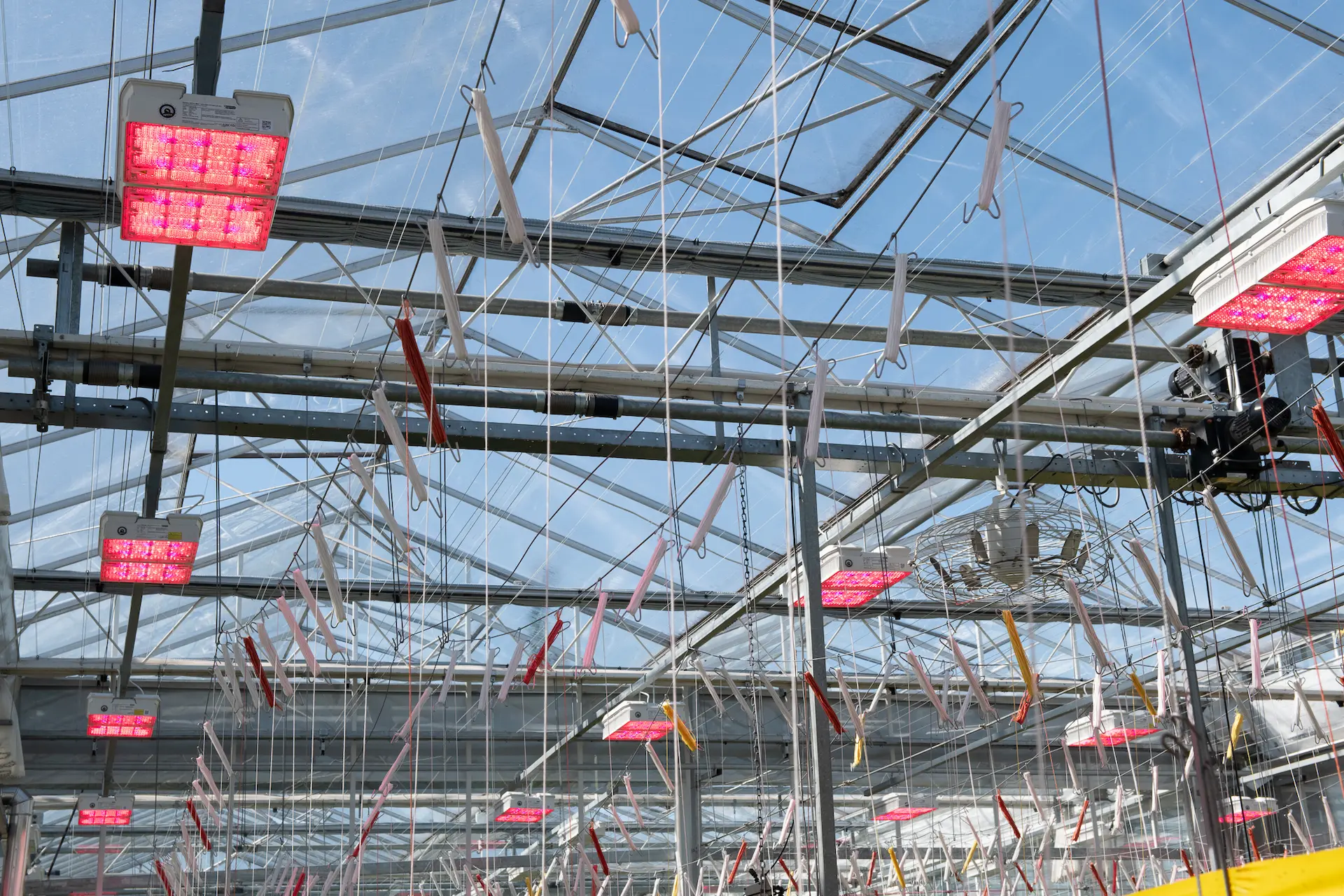
Greenhouse lighting affects total cost of ownership (TCO) through more than the purchase price. TCO adds up the investment, installation, electricity, maintenance, climate effects and crop results over the life of the system. For most growers, electricity is the largest running cost, so efficacy, controls and energy prices often shape the outcome.
The right answer depends on your crop, location, daylight, greenhouse structure and energy market. The sections below explain each cost component, compare LED and HPS, and show how controls and crop performance change the calculation.
Which cost components make up lighting TCO?
Lighting TCO is made up of the initial investment, installation, electricity, maintenance, climate-related costs and upgrade or end-of-life costs. Together, these show what a lighting system costs over its full working life, not just on the day you buy it.
Looking at each part makes comparisons fairer. A cheaper luminaire can become the more expensive option if it uses more electricity or needs more maintenance.
- Investment: luminaires, drivers, controls, gateways and any software.
- Installation: mounting, cabling, electrical connection capacity and the labour to commission the system.
- Electricity: usually the largest recurring cost, driven by installed capacity, operating hours and price per kWh.
- Maintenance: cleaning, lamp or component replacement and repairs.
- Climate effects: how much heat the lighting adds, which changes your heating and ventilation needs.
- Flexibility: the cost of adapting the system when crops, energy markets or technology change.
Greenhouse construction and height also matter. They influence how many luminaires you need and how evenly the light reaches the crop, which affects both the investment and the results.
How do LED and HPS compare over time?
LED and HPS differ in photon efficacy, heat output, maintenance and upfront cost, so the better long-term choice depends on your situation. LED often uses less electricity per unit of light, while HPS can suit greenhouses where its heat is useful. Neither is the right choice for every grower.
When you compare the two, look at the whole system and not only at electricity use. The factors below usually decide the result.
| Factor | LED | HPS |
|---|---|---|
| Photon efficacy | Often higher, depending on the product | Generally lower than modern LED |
| Heat distribution | Less radiant heat toward the crop, so the greenhouse climate may need adjusting | More radiant heat, which can reduce heating demand in cool periods |
| Spectrum and distribution | Can be designed for specific spectral and distribution needs | Broad, established spectrum with a different light distribution |
| Initial investment | Typically higher | Typically lower |
| Maintenance | Fewer lamp replacements | Regular lamp replacement |
| Control options | Dimming is generally straightforward | More limited intensity control |
Heat deserves particular attention. LED and HPS affect air movement, plant transpiration and the wider greenhouse climate in different ways. If you change from HPS to LED, you may need to review your heating strategy and climate settings to keep the crop in balance. This adjustment is a real part of TCO and is easy to overlook.
How do energy prices and efficacy shape running costs?
Running costs depend on how efficiently a luminaire turns electricity into light and on what you pay for each kilowatt-hour. A higher-efficacy luminaire delivers the same amount of light with less power, and the saving grows as electricity prices or operating hours increase.
Efficacy is measured in micromoles of photosynthetically active photons per joule (µmol/J). It shows how much usable light you get for each unit of energy. It is useful for comparing products, but a data sheet does not show how well the light is spread over your crop.
Several conditions decide how much efficacy matters in practice. The longer the system runs, the more electricity cost outweighs the purchase price. Fixed, variable and time-of-day tariffs all change the calculation. A greenhouse with more natural daylight needs less supplemental light across the year. Finally, your crop, variety and growth stage set how much light you need, expressed as PPFD (light intensity in µmol/m²/s) and DLI (the total light received per day, in mol/m²/day).
Because energy prices move, a business case built on one price can age quickly. Testing your TCO against a range of electricity prices gives a more reliable picture than relying on a single figure.
Can smart controls reduce lighting costs?
Yes, smart controls can help reduce lighting costs by adjusting light output to what the crop needs. When set up well, dimming based on daylight, DLI targets and electricity prices may lower energy use while still meeting the crop’s light requirements. Results depend on your control system and greenhouse conditions.
Dimming means changing the light intensity. It is different from dynamic spectrum control, which changes the colour composition of the light. Both can be useful, but they are separate functions and not every system supports both.
What does dynamic dimming rely on?
Dynamic dimming works best with good input data. This includes light measurements in the greenhouse, radiation forecasts, your DLI target and the electricity price at a given hour. The control system can then reduce intensity when daylight is strong or power is expensive, and raise it when the crop needs more light.
Why does photoperiod limit how freely you can shift light?
Light cannot simply be moved to the cheapest hours. Many crops respond to day length as well as to total light, so the required photoperiod must be respected. Shifting light to cheaper hours only works if the crop can tolerate it and the DLI target is still met.
Controls also need to connect reliably to many luminaires. Wireless connectivity through a gateway can support central control of large installations, which reduces cabling and makes changes easier. Check what your existing climate computer and greenhouse systems can integrate with before you decide.
How does crop performance factor into TCO?
Crop performance belongs in TCO because lighting exists to support production, so the value of the light matters as much as its cost. A lighting plan that fits your crop and greenhouse can support yield and quality, but no supplier can guarantee a specific result or payback period.
Performance depends on how well the system matches your crop. Light intensity, duration and spectrum can vary by crop, variety and stage of development. Uniform light distribution also matters, since uneven light can lead to uneven crops.
When you include crop results in your TCO, start with your production goals. Tomatoes, cucumbers, leafy greens, strawberries and ornamentals all respond differently to light. A lighting plan and light measurements help check that the design delivers what you intended. Market requirements also play a role, because retailers increasingly set sustainability and quality expectations for produce. Finally, a system you can expand or adjust may hold its value better as your crops and requirements change.
For this reason, ROI and TCO work best as a range of scenarios rather than a single number. Test the assumptions that matter most, such as energy price, operating hours and crop response, and compare your options on that basis.
How Agrolux helps with greenhouse lighting TCO
At Agrolux, we treat greenhouse lighting as a cultivation decision, not only a product choice. We start with your crop, greenhouse, location and existing technology, and then help you build a lighting strategy that you can evaluate on total cost of ownership.
In practice, this can include lighting plans based on your greenhouse structure, height and daylight conditions, and light measurements to check that the design works as intended. Our agronomists and plant scientists can advise on how light and spectrum may affect your crop. We offer both LED and HPS solutions, so the recommendation can fit your situation. For control and energy management, we can support dynamic lighting based on daylight, energy prices and crop requirements through software, compatible luminaires and wireless connectivity.
Where flexibility is important, a modular platform such as our LYRA™ LED system lets you start with one configuration and later add modules or replace drivers as requirements change. This can reduce the need to replace complete luminaires.
If you want to look at lighting costs across the full life of your system, we are glad to discuss your crop, greenhouse and energy situation with you. You can learn more about our approach at Agrolux or see our portfolio for examples of professional greenhouse lighting projects.
Related Articles
- How can growers improve light penetration in dense greenhouse crops?
- How can weather forecasts improve greenhouse lighting decisions?
- What is photon efficacy and why does it matter for greenhouse lighting?
- How does luminaire ageing affect light output and efficiency?
- How does greenhouse lighting interact with heating and ventilation?