


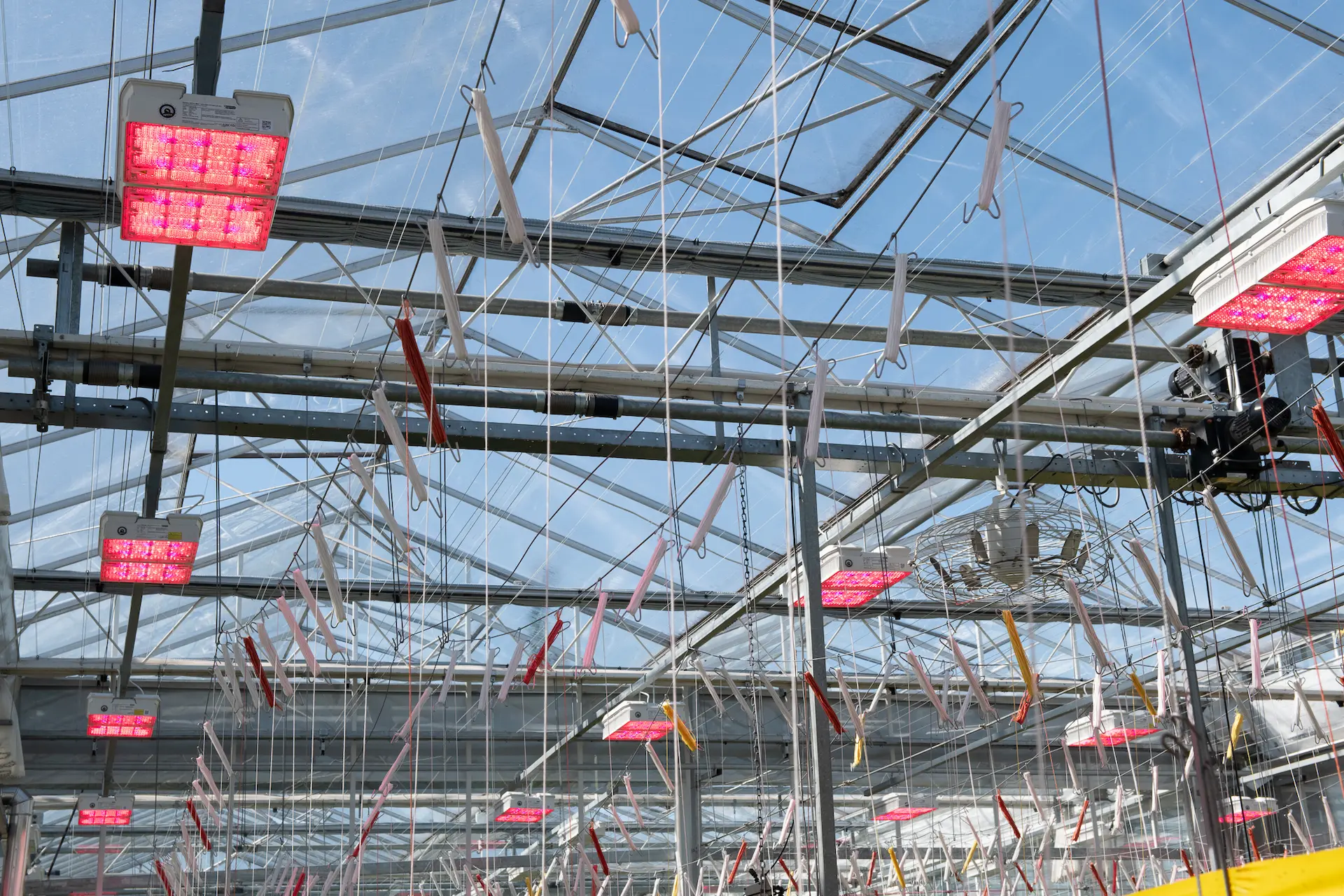
Luminaire ageing reduces light output gradually, and it usually lowers efficiency as well. LEDs lose output slowly, a process called lumen depreciation, while HPS lamps lose output faster and need regular replacement. How fast this happens depends on operating temperature, drive current, running hours and component quality. For a grower, the real question is whether the crop still receives the light it needs. This article explains why output declines, how LED and HPS ageing differ, how to measure it, and when to replace or retrofit.
What causes light output to decline in greenhouse luminaires?
Light output declines because the light source and the materials around it wear over time. In an LED, the chip and phosphor lose efficiency. In an HPS lamp, the arc tube and electrodes wear out. In both cases, dirt, moisture and ageing optics reduce output further.
Several factors work together. High temperature inside the LED speeds up chip and phosphor wear, especially when heat is poorly removed or the greenhouse is warm. Running LEDs at a higher current adds heat and shortens the time until output drops to a given level. Long photoperiods and year-round lighting add running hours much faster than seasonal use. Humidity and condensation can affect seals, connectors, lenses and reflectors. Dust, spray residue and algae film on lenses, covers and reflectors block part of the light before it reaches the crop. Finally, an ageing driver can change the current delivered to the light source, which may affect output and, in some cases, stability.
Not every loss comes from the light source itself. Part of it is a maintenance issue, and this can often be reversed by cleaning.
How does ageing differ between LED and HPS fixtures?
LEDs usually decline slowly and keep working at a lower output. HPS lamps lose output faster and eventually fail or become too inefficient to keep. Because the two technologies age differently, they need different maintenance planning.
HPS ageing is tied to the lamp. Output falls as the arc tube darkens and the electrodes wear. Many growers replace lamps on a schedule, often after a set number of operating hours, because output and efficiency drop before the lamp stops working. The reflector and the ballast or electronic control gear age as well.
LED ageing is more gradual. Lifetime is often described with L90 or L80 values. L90 is the number of hours until output falls to 90% of its initial value, and L80 is the point where it reaches 80%. These figures depend on test conditions such as temperature and drive current, and manufacturers do not always report them in the same way, so compare them with care.
The difference also matters for the greenhouse climate. LED and HPS fixtures give off heat differently, so ageing does not affect the crop environment in the same way. When you judge the effect of ageing, look at how your lighting interacts with air circulation, transpiration and climate control, not only at light output.
How much efficiency is lost as luminaires age?
Efficiency loss depends on the technology, the operating conditions and the quality of the components. In general, light output falls over time while power consumption stays similar, so you get less light for each unit of energy. We do not give a single percentage here, because it varies too much between products and installations.
Photon efficacy is measured in µmol/J, the number of photons delivered per joule of electrical energy. As a luminaire ages, its output in µmol/s drops. If the power draw stays the same, efficacy drops with it. With HPS, the power draw can also change as the lamp ages, which affects the picture further.
The practical result is that the installation delivers less PPFD than the original design. PPFD (Photosynthetic Photon Flux Density) is the number of photosynthetically active photons reaching a square metre each second, measured in µmol/m²/s. If PPFD falls, the DLI (Daily Light Integral), the total photosynthetically active light the crop receives over 24 hours in mol/m²/day, falls too, unless you compensate with longer lighting hours or higher intensity.
Whether this matters depends on your crop, cultivar, growth stage, natural daylight and production goals. A small drop may have little effect in one situation and a clear effect in another.
How can growers measure and track luminaire ageing?
You can track ageing by taking regular PPFD measurements at fixed points under the lighting and comparing them over time. Combine these readings with records of operating hours, power consumption and maintenance, so you can tell ageing apart from dirt or changes in the greenhouse.
A practical approach includes these steps:
- Set a baseline: Measure PPFD at defined positions after installation, or after cleaning, and record the conditions.
- Repeat measurements: Measure at the same positions and the same height, ideally without daylight, for example at night. Use a calibrated quantum sensor.
- Clean before you measure: Check whether dirt on lenses, covers and reflectors explains part of the drop.
- Compare with power data: Track energy use alongside output to see changes in efficacy.
- Look for PPFD drift: PPFD drift is a slow, often uneven change in light levels. Check whether some areas fall faster than others.
Uneven ageing is common. Luminaires in hotter zones or with longer running hours may decline faster. Mapping light levels across the greenhouse shows where the differences are largest, and it also shows which parts of the crop receive less light than planned. Sensor accuracy and calibration matter, so use the same equipment and method each time.
Can dimming or control strategies compensate for ageing output?
Dimming and control can partly compensate for ageing output, but only within the limits of the installation. If luminaires run below full power, you can raise intensity as they age. If they already run at full power, there is no room left. Compensation also has energy and heat costs.
It helps to keep two concepts apart. Dimming changes light intensity, while dynamic spectrum control changes the spectral composition. Compensating for ageing relies on dimming, and not every control system supports every function.
One option is to design the installation with headroom, so that it runs below maximum at the start and leaves room to raise output later. This affects investment and energy use, so it is a trade-off. Another option is to raise intensity on aged luminaires to bring PPFD back towards the target. You can also extend lighting hours to raise DLI, but you must respect the crop’s required photoperiod, because light cannot be redistributed freely without considering the plant’s biological needs. Dynamic dimming based on sunlight, forecasts, DLI targets and electricity prices can help manage output efficiently.
Compensation raises power use per unit of light and can increase heat load. Review the effect on both energy cost and greenhouse climate before you rely on it.
When should aged luminaires be replaced or retrofitted?
Replace or retrofit luminaires when they can no longer deliver the PPFD and DLI your crop needs at an acceptable energy cost, or when maintenance and failure rates become too high. The right moment depends on your crop, energy prices, installation design and investment plans.
Signs that it may be time to act include measured PPFD staying below target even after cleaning and at full output, and energy costs rising too much when you compensate with intensity or hours. Uneven light distribution with visible effects on the crop is another sign, as are HPS lamps reaching the end of their planned service life, or rising failure rates, driver problems or maintenance effort. Changes in your cultivation requirements, control needs or the energy market can also change the picture.
Replacing a single component can be an alternative to replacing the full fixture. Examples include lamps, drivers or light modules, depending on the design. Modular systems make this easier, because you can swap or add parts while keeping the structure. A move from HPS to LED is not automatically the right choice. Compare photon efficacy, light distribution, spectrum, heat distribution, greenhouse climate, investment and operating costs for your situation.
How Agrolux helps with luminaire ageing
We help growers understand how their installation performs today and what to do next. Our advice starts with your crop, greenhouse, location, existing technology and cultivation goals, not with a standard product.
We measure PPFD and light distribution to show how your current installation performs against your targets, and we compare LED and HPS options objectively, including efficacy, heat distribution and total cost of ownership. Our agronomists and plant scientists advise on how light level and spectrum relate to your crop and growth stage. We also support dynamic dimming strategies that take daylight, energy prices and crop requirements into account, and we create greenhouse-specific lighting plans for new, extended or renewed installations. Where it fits, our modular LED platform, LYRA™, lets you add modules and replace drivers, so you do not need to replace the complete luminaire when requirements change.
If you want to review how your luminaires have aged, or plan a retrofit or replacement, our specialists are happy to discuss your situation. Visit the Agrolux homepage to get in touch, or see our project portfolio for examples of greenhouse lighting installations.
Related Articles
- How does supplemental lighting support winter greenhouse production?
- How do greenhouse lighting controls respond to changes in daylight?
- How can greenhouse growers compare the efficiency of different lighting systems?
- What is photon efficacy and why does it matter for greenhouse lighting?
- How does greenhouse lighting interact with heating and ventilation?