


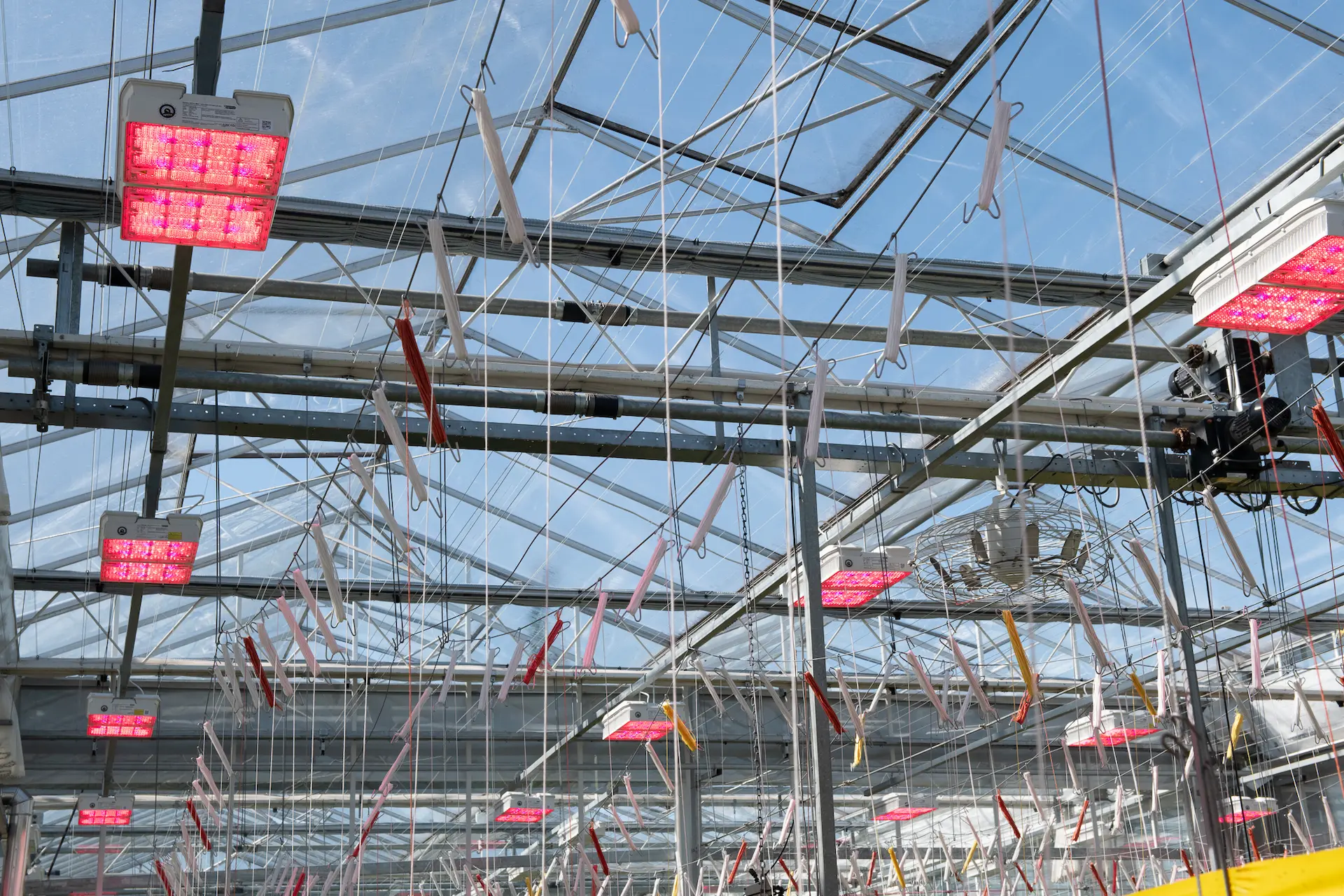
Weather forecasts can help growers plan supplemental light before the day starts. A forecast shows how much sunlight is likely to reach the crop, so you can dim, delay, or schedule lights against an expected daily light integral (DLI), instead of reacting to conditions as they happen.
How much this helps depends on your crop, greenhouse, location, and electricity prices. Below, we answer the main questions growers ask about using forecasts to control supplemental lighting.
Which forecast variables matter most for supplemental lighting?
Solar radiation is the most useful forecast variable, because it shows how much natural light your crop is likely to receive. Cloud cover, temperature, humidity, wind, and snow also matter, because they affect light transmission, greenhouse climate, and the lighting decision that follows.
A solar radiation forecast for your greenhouse location gives an hour-by-hour view of the natural light you can expect, measured in W/m². Cloud forecasts help explain why this value moves up or down. Thin high cloud and thick low cloud reduce radiation very differently. Outdoor temperature matters because lights add heat to the greenhouse, which can help or hinder your climate strategy. Humidity and wind affect transpiration, venting, and condensation risk, especially when lights and screens are used together. Snow on the roof can cut light transmission for hours or even days.
Outdoor radiation is not the same as the light that reaches your crop. The greenhouse cover, roof dirt, screens, and structure all reduce transmission. Measuring light inside your own greenhouse helps turn an outdoor forecast into a realistic estimate at crop level.
How do forecasts help predict the daily light integral?
A forecast lets you estimate how much natural light your crop will collect over the coming day. You compare that estimate with your DLI target and decide how much supplemental light is needed to close the gap.
It helps to separate two terms. PPFD (photosynthetic photon flux density, in µmol/m²/s) is the light intensity at the crop at one moment. DLI (daily light integral, in mol/m²/day) is the total amount of usable light the crop receives over 24 hours. A forecast mainly feeds the DLI calculation, while PPFD describes what is happening at any single moment.
A practical forecast-based approach follows these steps:
- Convert the forecast solar radiation into an expected PAR level, using your greenhouse’s measured transmission.
- Estimate the natural DLI for the day ahead.
- Compare it with the DLI target for your crop, cultivar, and growth stage.
- Calculate the shortfall that supplemental lighting should cover.
- Check that the plan still respects the crop’s required photoperiod.
DLI targets differ between crops, cultivars, growth stages, and production goals, so no single figure fits every greenhouse. Set your target together with your cultivation team or an agronomist, then use the forecast to manage against it.
When should lights be dimmed, delayed, or switched off?
Dim the lights when natural light already covers part of the DLI target. Delay them when a brighter period is expected later. Switch them off when forecast and measured light together reach the target. Each choice must still respect the crop’s photoperiod and biological needs.
Dimming
Dimming lowers light intensity so the lamps complement natural daylight. If the forecast shows bright conditions in the afternoon, lights can run at lower output during that period. Dimming changes intensity. It is different from dynamic spectrum control, which changes the spectral composition of the light. Not every control system supports both functions.
Delaying or switching off
If a clear spell is expected later, you can postpone the start of lighting and let the sun do more of the work. Once the accumulated light reaches the target, you can switch the lights off for the rest of the day. First check that your crop tolerates the resulting light pattern, because light cannot simply be moved between hours without considering the photoperiod and the crop’s response.
Many growers add safeguards to the control logic, such as minimum lighting hours, a maximum number of on and off switches per day, and special rules for early morning and evening, when radiation changes quickly.
How does forecast-based lighting affect energy costs and crop steadiness?
Forecast-based lighting can reduce electricity use by avoiding light that the sun would have supplied anyway. It can also help keep crop conditions steadier, because DLI is planned ahead. The results depend on your installation, control strategy, crop, energy prices, and local weather.
On the energy side, a forecast lets you combine two inputs: expected sunlight and electricity price. If prices are high during a bright period, you may rely more on daylight. If prices are low at another time, you may shift part of the lighting there, provided the photoperiod and crop response allow it. Savings are possible but not guaranteed, and the size of the effect varies from site to site.
On the crop side, the goal is consistent light delivery. Sudden swings between very bright and very dull days can lead to uneven light exposure, and planning against a DLI target may help smooth this out. Light also interacts with temperature, humidity, and transpiration. Lights add heat, and LED and HPS systems distribute that heat differently, so lighting decisions should be considered together with your climate strategy.
What tools connect weather data to greenhouse light control?
Weather data reaches your lighting through a chain of sources, software, and hardware: a forecast provider, an on-site weather station, a climate computer or control platform, and dimmable luminaires with a communication link. Each part needs to work with the others for forecast-driven control to run reliably.
The forecast itself should come from a meteorological or specialist provider, ideally for your exact location. A weather station and light sensors inside the greenhouse confirm what the forecast predicted and show the real transmission. A lighting control platform or climate computer calculates DLI, applies your rules, and sends commands. The luminaires must accept intensity commands, which is what makes dimming against daylight practical. Wired or wireless communication links the controller and luminaires, which matters most in large greenhouses with many fixtures.
Integration with your existing climate control is important. Lighting, screens, heating, and venting all affect each other, and a control strategy that ignores this can solve one problem while creating another. Check compatibility early, since not every system supports every function.
What are the limits and risks of forecast-driven lighting?
The main limit is forecast error. Weather predictions are never exact, so a plan built only on a forecast can deliver too much or too little light. Good systems combine forecasts with live measurements and let real conditions correct the plan during the day.
Broken cloud and fast-changing weather are hard to predict, particularly hour by hour. Regional forecasts may also miss local conditions at your site, such as fog or microclimate effects. Light transmission changes with roof dirt, snow, screens, and ageing cover materials, so measured values should be checked regularly. Some crops and growth stages respond poorly to large shifts in light timing, and peak load limits or contract terms can restrict how freely you shift lighting. Finally, a connectivity or data failure needs a safe fallback, such as a default lighting schedule.
Start with conservative rules, compare forecast and measured values over several weeks, and adjust. Treat the forecast as a planning input, not as a replacement for measurement and grower judgement.
How Agrolux can support your lighting decisions
The right lighting plan starts with your crop and your cultivation goals, and every greenhouse is different. Forecast-driven control works best when it reflects your crop, location, greenhouse structure, existing technology, and energy situation.
At Agrolux, we combine light measurements, agronomic knowledge, and lighting technology to help growers make informed choices. Measurements show how much light reaches your crop and how evenly it is spread. Our agronomists and plant scientists can discuss how light intensity, duration, and spectrum may affect your crop. Where it fits your situation, we can advise on LED and HPS lighting, with attention to heat distribution and the wider greenhouse climate, and on dynamic lighting and energy management. This combines compatible luminaires, software, and wireless connectivity so that light intensity can follow sunlight, energy prices, and crop requirements. Our modular LYRA platform can be expanded or modified as your requirements change.
If you would like to discuss how weather data could fit your lighting strategy, our specialists are happy to look at your crop, greenhouse, and energy situation with you. Visit our homepage to get in touch, or browse our portfolio to see how we approach different greenhouse projects.
Related Articles
- How does greenhouse lighting affect total cost of ownership?
- What Is PPFD and What Does It Tell You About Greenhouse Lighting?
- What is light-sum control in greenhouse lighting?
- How can greenhouse growers evaluate the long-term performance of their lighting system?
- How does dimming affect greenhouse lighting efficiency?