


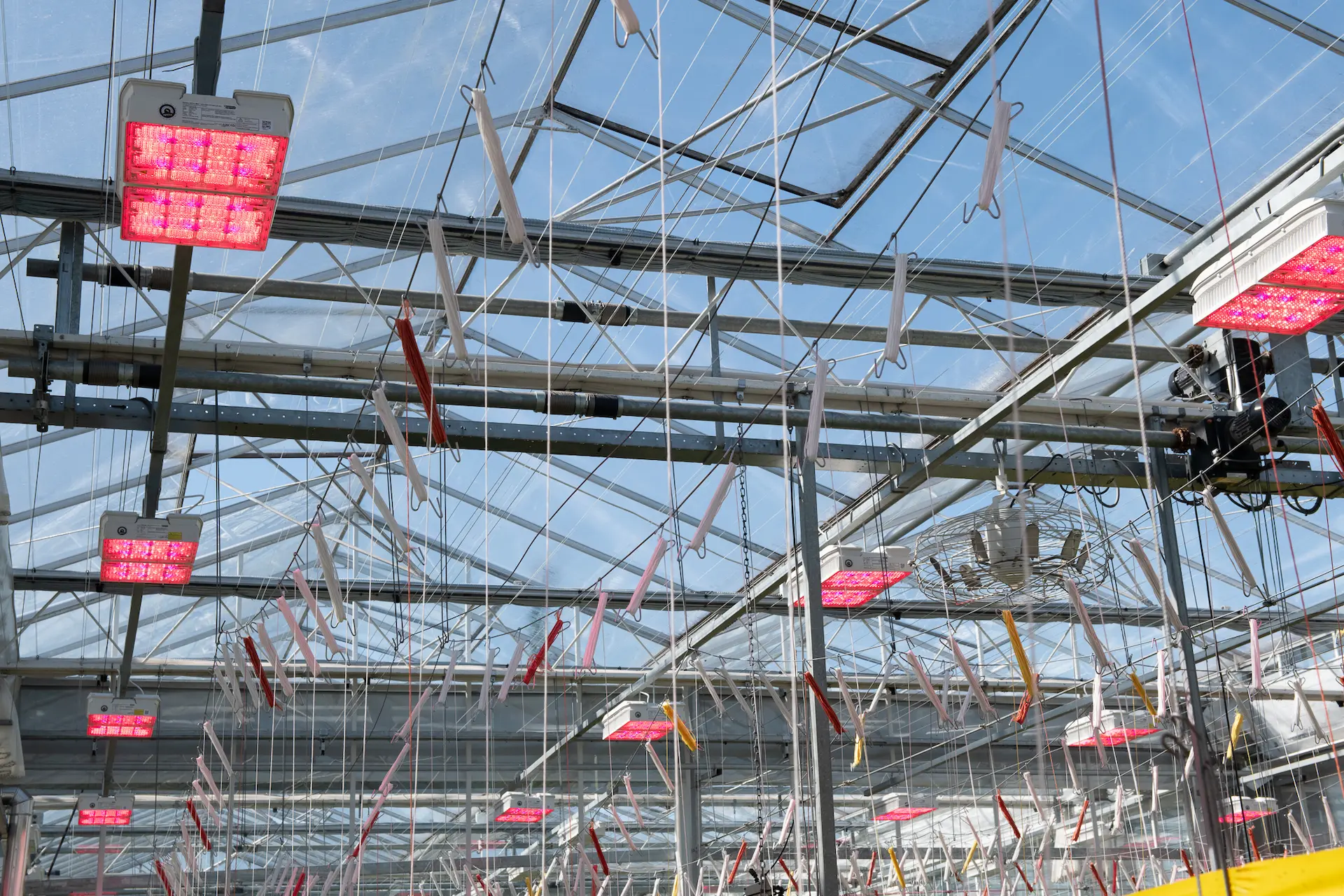
Greenhouse lighting interacts with heating and ventilation because every luminaire adds heat and light energy to the crop environment, which changes temperature, humidity, and air movement. Lighting can offset some heating demand, but it can also raise ventilation and dehumidification needs. For the crop, the goal is a stable climate, so the three systems work best when they are managed together.
How strongly these effects show depends on the light source, greenhouse construction, crop, season, and daylight. The sections below explain how much heat lights add, where they can replace heating, how they affect ventilation and humidity, and how to avoid control conflicts.
How much heat do greenhouse lights add to the crop environment?
Greenhouse lights add heat in two ways: as radiant energy that warms leaves, structures and air, and as convective heat from the luminaire itself. The amount depends on the technology, installed capacity, dimming level, and how long the lights run.
Almost all the electricity a luminaire uses ends up as heat in the greenhouse in some form. The difference between technologies is where that heat goes. HPS luminaires release a large share of their energy as radiant heat, which warms the canopy and the greenhouse air directly. LED luminaires release less radiant heat toward the crop. Most of their heat leaves through the fixture body and warms the air by convection, so the canopy is usually cooler for the same amount of light.
This difference can affect leaf temperature, transpiration, and the air temperature at crop level. It also changes how much heat is available to reduce your heating demand. Heat distribution varies with luminaire design, mounting height, and air circulation, so measuring your own greenhouse gives more reliable information than general figures.
Can grow lights replace some greenhouse heating?
Grow lights can replace part of your greenhouse heating, mainly during the hours when they run and the outside temperature is low. They rarely replace the heating system completely, because the heat they supply follows the lighting schedule, not the crop’s temperature needs.
The benefit is largest with light sources that release a lot of radiant heat, such as HPS. In a cold period with the lights on, the heating system may need to supply less heat. When you change to LED, the lights contribute less heat, so the heating system may run more often than before. This is worth including in your energy planning, which is one reason to look at the whole energy balance and not only the electricity bill.
How much heating you can displace depends mostly on the light technology and dimming level, the outdoor climate and season, and the greenhouse construction. Glazing, screens, and insulation decide how much heat stays inside, and the benefit is usually greater in cold, low-light periods.
Lights run for crop reasons first. Using them for heat only makes sense when the lighting is also justified by the crop’s light requirements, including its DLI target (daily light integral, the total amount of light the crop receives in a day) and photoperiod. Extending the lighting period or raising intensity just to gain heat is not a good strategy, because it can push the crop away from its optimal growing conditions.
How does supplemental lighting change ventilation and humidity needs?
Supplemental lighting can raise transpiration and leaf temperature, which increases the moisture load in the greenhouse air. This often means more ventilation or dehumidification is needed during lighting hours, especially in winter when venting also removes expensive heat.
More light drives photosynthesis, and the plant opens its stomata (the small pores in the leaves) to take in CO₂. As it does, it also releases more water vapour. In a closed or semi-closed greenhouse, that moisture can build up and relative humidity may rise, particularly when outdoor air is cold and humid.
The effect varies between lighting technologies. Because LED luminaires warm the canopy less, leaf temperature and transpiration may differ from what you were used to under HPS, and some growers see changes in air circulation and humidity patterns after switching. You may need to review your humidity setpoints and dehumidification strategy, your minimum pipe temperature and venting settings, and your air circulation, for example with horizontal airflow fans.
Crop type matters here. A dense tomato or cucumber canopy transpires differently from a young propagation crop or a pot plant, so the same lighting plan can create different humidity demands in different houses.
What conflicts arise between lighting, heating, and venting controls?
The most common conflicts occur when lights add heat while the climate computer is trying to hold temperature, so it opens the vents while the heating pipes are still warm. Lighting, heating, and venting then work against each other and waste energy.
These conflicts usually show up in a few ways:
- Heating and venting at the same time: Lights raise the air temperature, vents open to cool, and the heating system reheats the air for humidity control.
- Dimming without climate adjustment: When lights dim because of daylight or electricity prices, heat input changes quickly and the heating system may lag behind.
- Humidity control versus energy saving: Venting for dehumidification loses heat, while keeping vents closed saves heat but raises humidity.
- Different schedules: Lighting follows photoperiod and DLI logic, while climate settings follow temperature and humidity logic, and neither system knows what the other is doing.
These problems are usually a control issue, not a hardware fault. When each system makes decisions on its own, the result is often a compromise that suits none of them. Clear priorities, shared data, and tuned setpoints can reduce the problem and help keep conditions steady for the crop.
How can lighting be integrated with the climate computer?
You integrate lighting with the climate computer by sharing information in both directions: the climate system knows when and how strongly the lights run, and the lighting control knows the greenhouse conditions. How far you can take this depends on what your controls support.
Integration can take several forms, from simple to advanced:
- Basic switching: The climate computer turns lights on and off based on a schedule or light sensor.
- Dimming control: Light intensity follows daylight, accumulated DLI, and sometimes electricity prices, while respecting the crop’s photoperiod.
- Heat compensation: The climate computer accounts for the heat from the lights when it sets heating and venting, so it does not heat and vent at once.
- Data sharing: Light, energy, and climate data feed into one overview that supports better decisions.
Not every control system supports every function, so check compatibility before you plan upgrades. Also keep dimming (changing intensity) separate from dynamic spectrum control (changing the spectral composition). They are related but different tools, and they affect the climate in different ways.
Wireless connectivity can simplify the connection between many luminaires and a central controller, which is useful in large greenhouses. Good integration supports your energy management, but it does not promise a specific saving. The result depends on your setup, crop, and energy prices.
What should growers weigh when choosing LED, HPS, or hybrid lighting?
Start with what the crop needs, then weigh photon efficacy, heat output, light distribution, investment cost, and how the choice fits your heating and climate system. No option suits every greenhouse. LED, HPS, and hybrid setups each suit different crops, locations, and energy conditions.
The table below summarises the main differences that relate to heat and climate.
| Factor | LED | HPS | Hybrid |
|---|---|---|---|
| Heat toward the crop | Lower radiant heat | Higher radiant heat | Mixed |
| Effect on heating demand | Heating may run more | Heating offset during lighting | Depends on the ratio |
| Light distribution and spectrum | Flexible, depends on the design | Fixed spectrum, broad pattern | Combined |
| Dimming and control options | Wide range, depends on the system | More limited | Depends on the setup |
| Investment and maintenance | Higher upfront, different upkeep | Lower upfront, regular lamp replacement | Varies |
Also consider your cultivar and growth stage, the natural light at your location, greenhouse height and construction, existing technology, and electricity and gas prices. A hybrid system can suit growers who want to keep some radiant heat while adding LED efficiency and control. A lighting plan based on your own greenhouse and crop gives a far more reliable answer than a general rule.
How Agrolux supports growers with lighting, heating and ventilation
At Agrolux, we look at lighting as part of the whole cultivation environment, starting with your crop, greenhouse, location, and existing climate technology. One luminaire does not fit every situation, so we work from your growing goals.
Our agronomists and plant scientists can advise on how light and spectrum relate to your crop. We can also help with light measurements and light distribution analysis to show what reaches the canopy, and with lighting plans that take daylight, construction, and energy prices into account. For LED and HPS installations, we can explain how each option may affect heat distribution, air circulation, and your climate. Where it fits your situation, we also offer lighting control and energy management, including dynamic dimming and wireless connectivity, and modular technology such as our LYRA™ platform, so you can adapt your system as requirements change.
If you want to talk through how lighting fits with your heating, ventilation, and climate strategy, our specialists are happy to look at your situation. Visit the Agrolux homepage to get in touch, or view our project portfolio to see how we work with growers.
Related Articles
- What is the difference between light intensity and light duration?
- What happens when greenhouse crops receive too little light?
- How does greenhouse lighting affect total cost of ownership?
- How does dimming affect greenhouse lighting efficiency?
- How Does Dynamic Lighting Help Greenhouse Growers Manage Energy Use?