


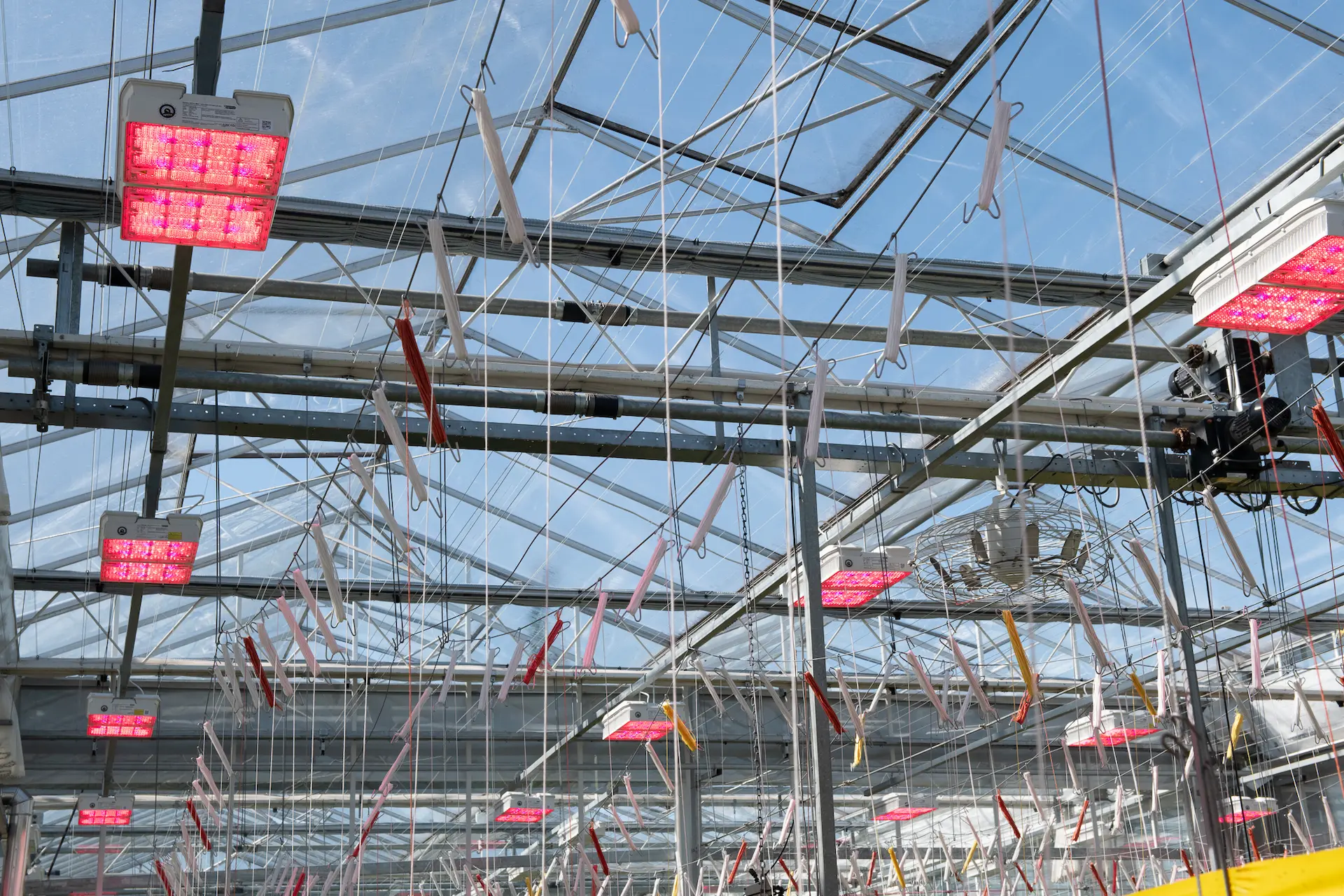
Light quality is the colour balance of the light a crop receives. It affects how plants grow, flower and fruit. Different wavelengths trigger different responses, from stem length and leaf size to flowering time and fruit quality. The effect depends on the crop, cultivar, growth stage and the amount of natural daylight. Below, we answer the most common questions about light quality and greenhouse crop development.
Which light wavelengths drive plant growth and morphology?
Light between 400 and 700 nanometres (nm), known as photosynthetically active radiation (PAR), drives photosynthesis. Blue, green and red light each play a different role. Chlorophyll absorbs blue and red most strongly, while green light reaches deeper into the canopy and still contributes to photosynthesis.
Plants also sense light through photoreceptors that regulate shape and development. This is called photomorphogenesis. In practice, the main wavelength ranges work as follows:
- Blue light (roughly 400 to 500 nm): influences blue light plant morphology. It is linked to compact growth, shorter internodes (the stem sections between leaves), leaf thickness and stomatal opening.
- Green light (roughly 500 to 600 nm): reaches lower leaves more easily than red or blue, and can influence shade responses.
- Red light (roughly 600 to 700 nm): drives photosynthesis efficiently and affects stem elongation, leaf expansion and flowering.
- Far-red light (roughly 700 to 800 nm): sits just outside the PAR range but can strongly affect plant shape and development.
It helps to separate light quantity from light quality. PPFD (photosynthetic photon flux density, in µmol/m²/s) measures how many photosynthetic photons reach a square metre each second. DLI (daily light integral, in mol/m²/day) measures the total received over a day. Spectrum describes the colour balance within those photons. Two lamps can deliver the same PPFD and still lead to different crop responses because their spectra differ.
How does the red to far-red ratio affect crop architecture?
A low red to far-red ratio signals neighbouring plants or shade. Many crops respond by growing longer stems and petioles (leaf stalks) and larger leaves. A higher ratio tends to produce more compact plants. The red far-red ratio is detected by phytochrome, a photoreceptor that tells the plant how crowded its surroundings are.
In a dense greenhouse canopy, leaves absorb red light and transmit or reflect far-red. Lower leaves therefore receive light with a lower red to far-red ratio. Plants read this as competition and may stretch towards the light. This is known as the shade avoidance response.
What this means for growers differs between crops. In propagation and young plants, extra far-red can increase stem length and leaf area. Sometimes growers want this, for example to intercept light faster, and sometimes they do not. In potted plants and cut flowers, stem length is often a quality criterion, so spectrum can influence how much growth regulation is needed. In fruiting crops such as tomatoes and cucumbers, far-red can influence plant balance and light distribution within the canopy.
Far-red effects are not uniform. Results differ between species and cultivars, and they interact with temperature, plant density, light intensity and daylight conditions. Treat far-red as something to test on your own crop rather than a rule that applies everywhere.
Does light spectrum change yield, quality and flowering?
Light spectrum can influence yield, product quality and flowering, but the size and direction of the effect depend on the crop and growing conditions. Total light quantity usually remains the main driver of yield. Spectrum works on top of that by shaping plant structure, development speed and quality traits.
The light spectrum plant development effects most often discussed by growers fall into three areas. For yield, spectrum can change leaf area, light interception and how light is distributed through the canopy, which affects how efficiently available light turns into biomass. For quality, blue light is often associated with compactness and leaf thickness, and spectrum may also influence colour, firmness and compound content in some crops, though responses vary. For flowering, many species respond to photoperiod (day length), and spectrum can modify that response. Far-red and red light interact through phytochrome, which affects flowering time in some short-day and long-day plants.
Research into spectrum effects is ongoing. For example, different light spectra in strawberry cultivation are being studied as production moves from outdoor fields into controlled greenhouses. Findings from one crop or trial should not be assumed to carry over to another.
Spectrum cannot replace adequate intensity or the correct photoperiod. A crop with a fixed photoperiod requirement cannot simply receive its light at different times to suit energy prices, whatever the spectrum.
Is LED or HPS better for managing light quality?
Neither technology is better in every situation. LED offers much more control over spectrum, while HPS delivers a broad, warm spectrum with strong radiant heat. The right choice depends on the crop, greenhouse climate, energy prices, existing infrastructure and investment plans.
For LED vs HPS greenhouse decisions, light quality is only one factor. With LED, the greenhouse LED lighting spectrum can be tuned, for example with different shares of red, blue and far-red. HPS has a fixed spectrum dominated by yellow, orange and red wavelengths, with comparatively little blue. Modern LEDs generally convert electricity into photons more efficiently, but actual savings depend on the installation, control strategy and energy prices.
Heat is another point. HPS gives off considerable radiant heat, which can reduce heating needs in some climates and seasons. LED gives off less radiant heat, so your heating strategy may need to change. The shape of the luminaire and its mounting position also affect how evenly light reaches the canopy, including the lower leaf layers. LED usually costs more upfront, and maintenance needs and lifetime differ between technologies. Some growers combine LED and HPS to balance spectrum, heat and cost.
Dimming and spectrum control are different things. Dimming changes light intensity, for example in response to daylight or electricity prices. Dynamic spectrum control changes the wavelength composition. Not every system supports both, so check what a given installation can actually do.
How should growers choose a spectrum for each crop?
Start from the crop’s goals, then test and measure. A good crop-specific light recipe takes into account the crop and cultivar, growth stage, natural daylight, greenhouse climate and production target. No single spectrum suits every grower or every crop.
A practical approach follows these steps:
- Define the goal. Decide what matters most: compact plants, faster propagation, stem length, flowering control, fruit quality or stable yield.
- Review your conditions. Look at your location, season, glass type, daylight levels and existing climate control.
- Set intensity and photoperiod first. Establish suitable PPFD and DLI targets for your crop and stage, within its photoperiod needs, before fine-tuning the spectrum.
- Check light distribution in the canopy. See how much light, and what kind, reaches lower leaves and fruit trusses.
- Trial and measure. Compare spectra on a small section where possible, and record plant response, quality and energy use.
- Adjust over time. Crops, cultivars and seasons change, so review your recipe regularly.
The same crop can need different treatment in propagation, vegetative growth and production. Light measurements in your own greenhouse give more reliable guidance than general figures from other sites.
How Agrolux supports growers with light quality
Choosing a spectrum is rarely a matter of picking a product. We start with your crop, greenhouse and cultivation goals, and only then look at which lighting approach fits. Our specialists work alongside you during evaluation and implementation, and we collaborate with research and educational institutions, including Wageningen University & Research and HAS Green Academy.
Depending on your situation, we can help with light measurements to check intensity and distribution in your canopy, and with agronomic advice on how spectrum, intensity and photoperiod work together for your crop. We can also help you compare LED and HPS options objectively, and plan lighting control and energy management that fit your daylight conditions and cultivation requirements. Modular technology makes it easier to adapt as your crop needs change.
If you want to talk through light quality in your own greenhouse, our specialists are happy to discuss your crop, lighting requirements and energy challenges. You can reach us through the Agrolux homepage, or look at our portfolio to see how we approach different greenhouse projects.
Related Articles
- How many hours of supplemental lighting do greenhouse crops need?
- How does greenhouse lighting affect total cost of ownership?
- What Is PPFD and What Does It Tell You About Greenhouse Lighting?
- What should growers consider when upgrading an existing greenhouse lighting system?
- How can greenhouse growers evaluate the long-term performance of their lighting system?