

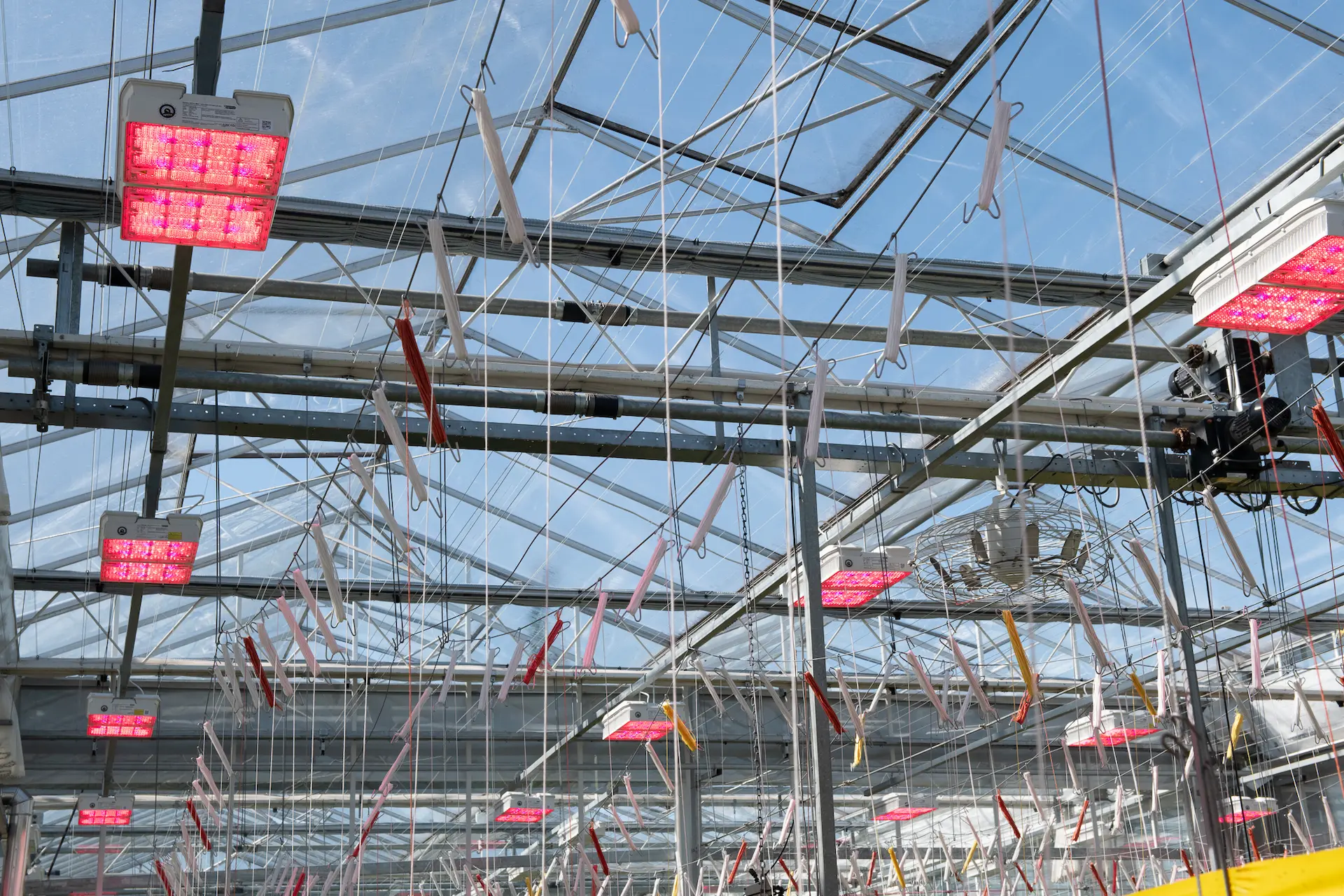
Light intensity at the plant falls as the distance between the luminaire and the crop increases, because the same light spreads over a larger area. Moving a fixture closer raises PPFD (the amount of light reaching each square metre of crop per second). Moving it higher lowers PPFD and usually improves uniformity. The exact effect depends on the fixture type, its optics and the greenhouse conditions.
Distance affects two things at once: how much light reaches the crop and how evenly it is spread. The sections below explain how the inverse square law applies, how fixtures differ, how to measure the result, and what can go wrong when the distance does not suit the crop.
Does the inverse square law apply to grow lights?
The inverse square law applies fully to a small point source of light, but only partly to real grow lights. For a point source, doubling the distance cuts the intensity to one quarter. Horticultural luminaires are larger than a point, so the drop is usually less steep close to the fixture.
The law works well when the distance is large compared to the size of the light source, because the luminaire then behaves almost like a point. Close to a large fixture, light arrives from many positions across its surface, so the intensity changes more gently as you move away. Optics and reflectors, the beam angle, overlap from neighbouring fixtures and reflection from greenhouse glass, screens and the crop itself all shape the result as well.
For this reason, the inverse square law helps you understand direction and scale, but it cannot give exact PPFD values. A measured or simulated light plan gives a more reliable answer for your own greenhouse.
How does fixture type change the distance effect?
Each luminaire has its own size, optics and light distribution, so the effect of distance differs from one fixture to another. A large, wide-beam fixture spreads light over a broad area and loses intensity gradually. A compact, narrow-beam fixture concentrates light and shows a stronger change in PPFD as the distance changes.
Both LED and HPS lighting are used in professional greenhouses, and they behave differently at the canopy.
HPS luminaires
HPS fixtures usually have a single, strong light source combined with a reflector. The reflector shapes the beam and influences how evenly the light lands on the crop. HPS luminaires also give off a large amount of radiant heat. This affects how close they can hang, because leaf temperature and crop stress may become limiting before light intensity does.
LED luminaires
LED fixtures spread the light source across many small emitters, and the optics differ widely between designs. Some distribute light over a large surface, which can allow a lower mounting height with good uniformity. Others use narrower optics. LEDs generally produce less radiant heat towards the crop than HPS, but this depends on the design. It does not remove the need to check canopy temperature and air movement.
Neither technology is automatically better for every distance or crop. The right choice depends on greenhouse height, crop, existing technology and lighting strategy, as well as energy prices and climate.
What is the right distance between lights and crops?
The right distance is the one that delivers the target PPFD at the canopy with acceptable uniformity, without causing heat or light stress. There is no single correct distance for all crops. It depends on the crop, its growth stage, the fixture and the structure of your greenhouse.
Start with the crop. Light targets (PPFD and DLI, the total light received per day) vary by crop, cultivar, growth stage and the amount of natural daylight. Then look at the fixture, because its beam angle and optics decide how far apart fixtures can be and how high they can hang.
Crop height also matters. Tall crops such as tomatoes and cucumbers grow towards the light during the season, so the distance to the top of the plant keeps changing. The greenhouse sets practical limits too: gutter height, trellis wires, screens and heating pipes all restrict the possible mounting height. Finally, dimming lets you adjust intensity, but the crop’s biological need for a certain photoperiod stays the same.
Closer fixtures give higher intensity directly below them but usually less uniform light. Higher fixtures spread the light more evenly but need more output to reach the same PPFD. The best position balances these effects for your crop.
How can light intensity be measured at canopy level?
You can measure light intensity at canopy level with a quantum sensor (a PPFD meter) held at the height of the top of the crop. It reports PPFD in µmol/m²/s. Readings at many points show both the average intensity and the uniformity.
A reliable measurement takes a few practical steps:
- Measure at the actual canopy height, not at floor level.
- Take readings across a grid, including positions directly below a fixture and between fixtures.
- Measure with and without natural daylight, because daylight adds to the total light the crop receives.
- Use a sensor suited to horticultural light, and check that it is calibrated.
- Repeat the measurements as the crop grows, since the canopy height changes.
Keep in mind that PPFD is an instantaneous value. It tells you how much light reaches the crop at a given moment. DLI, measured in mol/m²/day, describes the total light received over 24 hours. A good PPFD reading does not guarantee a good DLI, because the photoperiod and daylight conditions also count. Light plans and simulations can predict the PPFD distribution before installation, and measurements afterwards show whether the installation performs as planned.
What problems can incorrect light distances cause?
An unsuitable light distance can lead to uneven crop growth, stress from too much light or heat, and wasted energy. If lights hang too close, parts of the crop may receive too much light and heat. If they hang too far away, the crop may not reach its target PPFD or DLI.
Uneven light is often the first sign. Bright spots and dark patches can lead to differences in growth, development and ripening across the crop. Fixtures that are too close can raise leaf temperatures, especially with the radiant heat from HPS. Fixtures that are too far away may not deliver the intended PPFD, even at full output. Making up for a poor distance with extra output can raise electricity use without improving crop performance. Narrow crops and edges may also receive less light than the centre of the greenhouse.
The effects differ between crops and cultivars, and plants respond to light intensity in different ways. It is worth checking how your own crop reacts and adjusting with the help of measurements and agronomic advice.
How do greenhouse conditions affect the best light distance?
Greenhouse conditions affect the best light distance through structure, natural daylight, climate and crop growth. A greenhouse with limited height, strong sunlight or high temperatures needs a different mounting height and lighting strategy than a tall, cooler one.
Greenhouse height and construction, including gutter height, trusses, screens and installations, define how high you can place luminaires. Location and season determine how much daylight supplements artificial light, which changes the PPFD you need from the lights. Temperature, humidity and air circulation influence how plants respond to light and to heat from the luminaires, and LED and HPS distribute heat differently, which can change air movement, transpiration and the wider greenhouse climate.
The crop stage and cultivation system matter as well, since young plants, propagation and tall crops need different distances and intensities. Energy prices and control strategy also play a role. Dimming based on daylight, DLI targets and electricity prices changes how much output you use at different times.
Because these factors interact, light distance is best treated as part of the overall growing environment. A lighting plan that considers the whole greenhouse is likely to give a more dependable result than a rule of thumb.
How Agrolux helps with grow light distance and light intensity
Every greenhouse is different, so we do not recommend a standard distance or a single luminaire for a crop. We start with your crop, cultivation strategy, location and existing technology, and then look at which lighting approach fits your situation.
Where relevant, we can support you with greenhouse-specific lighting plans that calculate PPFD and light distribution for your greenhouse height and crop, and with light measurements at canopy level so you can compare plan and practice. Our agronomists and plant scientists can give input on how light affects your crop and growth stage, and we can advise on LED and HPS solutions, including their effect on heat distribution and greenhouse climate. We also work with growers on dimming and energy management that take daylight, crop requirements and energy conditions into account. For modular technology such as LYRA, you can modify or expand the system as your requirements change.
If you want to review the light distance in your greenhouse, you are welcome to discuss your crop and lighting requirements with our specialists. Visit the Agrolux homepage to get in touch, or look at our portfolio for examples of greenhouse lighting projects.
Related Articles
- How does crop canopy density affect light penetration?
- What happens when greenhouse crops receive too little light?
- How can growers adapt greenhouse lighting during cloudy weather?
- What is the difference between measuring light above and within the crop canopy?
- How does greenhouse lighting influence CO₂ uptake and photosynthesis?