


More light is more yield?
More light = more yield. But…
Assimilation light is used for improvements in both the quality and quantity of yield. Yield increase is for most growers the most important reason to invest in LED (or HPS). In tomatoes, a rule of thumb is: 1% more light = 1% more yield. While this is roughly true, there is some more nuance to it. We will elaborate on this from a few different perspectives in the coming articles. In this article, we focus on spectrum.
Basically, plants use light for photosynthesis to produce assimilates, which they can invest in growth. In LED, we use roughly 4 light colours: blue, green/white, red, and farred. We will focus on the first 3 colours, as these are part of the PAR light, or Photosyntetically Active Radiation. This means that the plants can use this light directly for photosynthesis. However, the different colours are not all equally efficient for photosynthesis.
The McCree curve describes the quantum efficiency of photosynthesis at different wavelengths. When we focus on the 3 PAR light colours, we see that plants can use red light most efficiently, then green, then blue. The saying “1% more light = 1% more growth” is based on a balanced lighting recepy, with for instance 90% red, 5% blue and 5% green. So why don’t we use purely red light? Let’s look at each colour, and their purpose.
Red: Most important colour for efficient photosynthesis and therefore growth.
Blue: Blue light is a “signal colour” for plants, meaning that it affects the way they grow. The more blue light is added, the more compact the plant grows.
Green: This colour was not used much in assimilation lighting at first, and is now added mostly because humans need it to see well in greenhouses with only LED. When HPS is present, or sufficient daylight, the green part is not neccessary.
So all colours (within the PAR spectrum) have their function, and all of them contibute to photosynthesis, but not always equally.
PAR colours | Wavelength | Average Relative photosynthetic efficiency |
Blue | 400-500 | 70% |
Green | 500-600 | 88% |
Red | 600-700 | 100% |
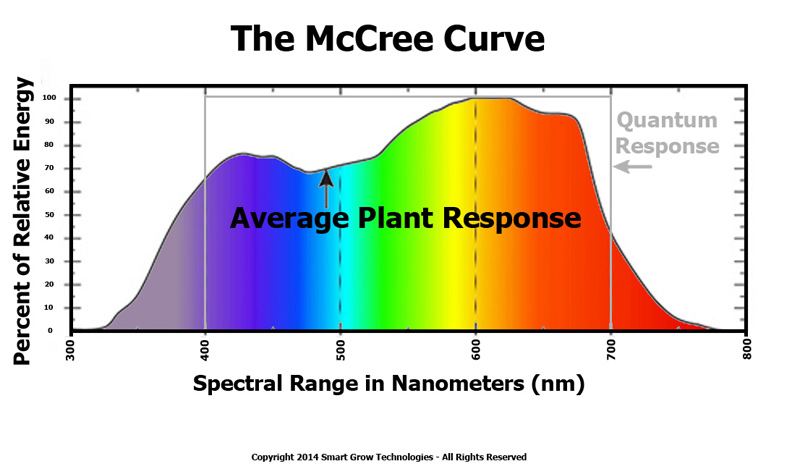
The McCree Curve