


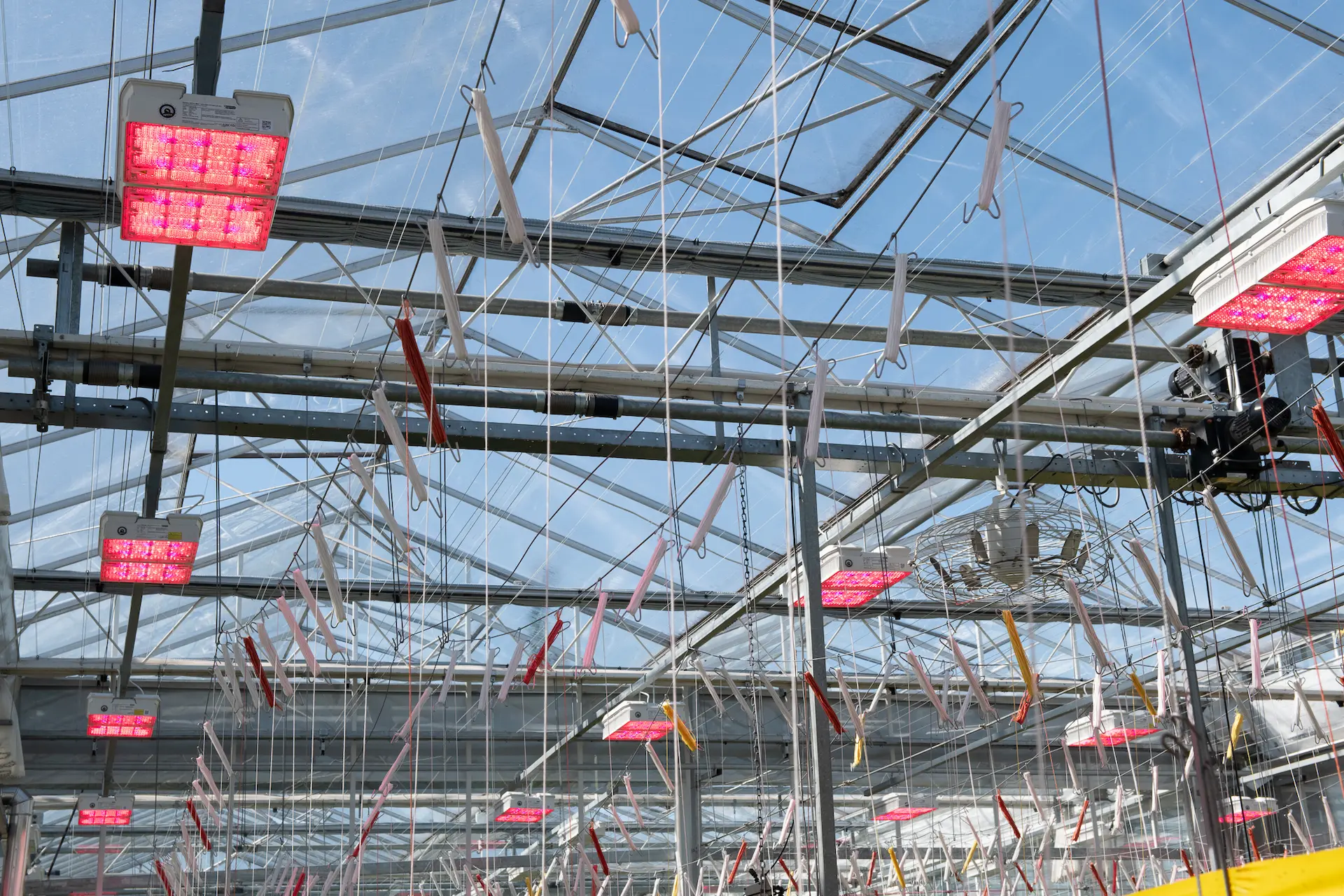
Most greenhouse crops that need supplemental lighting are lit for roughly 12 to 18 hours a day. The right number depends on the crop, the growth stage, the natural daylight available and the daily light integral (DLI) you want to reach. Your target DLI sets the total amount of light the crop needs. The photoperiod, the energy price and the crop’s biology then decide how that light is spread across the day.
There is no single schedule that suits every greenhouse. Below, you will find out how DLI shapes lighting hours, how crop types and seasons change the schedule, where the biological limits sit, and how you can reduce lighting hours without losing production.
How does daily light integral determine lighting hours?
Daily light integral (DLI) is the total amount of light your crop needs each day, and it is the starting point for planning lighting hours. Supplemental lighting fills the gap between that target and the daylight available. A larger gap usually means more lighting hours, higher intensity, or both.
DLI is the total photosynthetically active radiation received over 24 hours, measured in mol/m²/day. PPFD (photosynthetic photon flux density) is different. It describes how many photons reach one square metre every second, measured in µmol/m²/s. Think of PPFD as the speed of the light and DLI as the total amount collected over the day.
This difference matters for scheduling. You can reach the same DLI with a lower PPFD over more hours, or a higher PPFD over fewer hours. The two options are not always equal, though. Crops respond to intensity and duration in different ways, and the best combination depends on the crop, cultivar, growth stage and greenhouse climate.
In practice, the planning follows four steps:
- Set the DLI target for your crop and growth stage.
- Estimate the DLI from natural light, taking greenhouse transmission into account.
- Calculate the shortfall.
- Choose a combination of PPFD and lighting hours that closes the gap within the crop’s photoperiod limits.
DLI targets vary widely between crops. They are best set together with your agronomic advisor, based on your own production goals.
How many hours of supplemental light do common greenhouse crops need?
Fruiting vegetables such as tomatoes and cucumbers are commonly lit for long photoperiods during low-light periods. Leafy greens, soft fruits and propagation crops follow different patterns. The exact hours depend on the crop, cultivar, growth stage and the DLI you aim for.
Supplemental lighting for tomatoes and cucumbers
Tomatoes and cucumbers are high-light crops, and growers often run supplemental lighting for many hours per day in winter. Tomatoes tolerate long photoperiods well, but they still need a dark period for healthy development. Cultivar choice, plant load and greenhouse climate all influence how much light the crop can use. Because supplemental lighting for tomatoes is a large energy cost, many growers adjust hours and intensity to the season rather than running a fixed schedule.
Leafy greens, soft fruits, cut flowers and propagation
Leafy greens often respond to a steady daily light total, so the schedule is usually built around DLI and cost. Strawberries and other soft fruits can be sensitive to day length, so lighting hours may affect flowering and fruit set as well as growth. Cut flowers and potted plants add another layer. Some species flower in response to day length, so the photoperiod is part of the crop plan and not only an energy decision. Propagation usually uses a controlled photoperiod at lower intensity.
Because of these differences, treat any hours you read in general guides as a starting point. Check the schedule against your cultivar, your growth stage and your greenhouse conditions.
How do seasons and outdoor light change lighting schedules?
Seasons change lighting schedules because natural daylight changes in both length and intensity. In winter you need more supplemental light for longer. In spring and autumn you need less. In bright summer conditions you may need little or none. Your location and greenhouse structure change the picture further.
Latitude plays a large role. A greenhouse in the Netherlands or the Nordics sees very different winter daylight from one in the southern United States or Turkey. Greenhouse construction, glass type, height, screens and cleanliness all affect how much outdoor light reaches the crop.
A fixed lighting schedule can waste energy on bright days and fall short on dark ones. Many growers now adjust lighting to the day instead. They compare the light already received, the forecast and the DLI target, then decide how much supplemental light to add. This is often called dynamic lighting.
Dimming is one part of this. It changes light intensity based on daylight, accumulated DLI, crop needs or energy conditions. It is separate from dynamic spectrum control, which changes the colour composition of the light. Not every control system supports both, so check what your installation can do.
Can crops get too much supplemental light or no dark period?
Yes. Crops can receive too much light, and many do poorly without a dark period. Excess light can cause stress, leaf damage or wasted energy. A missing dark period can disturb plant processes and, in some crops, lead to disorders. Tolerance varies by species and cultivar.
Too much light can show up as leaf scorching or bleaching, as extra light that adds little growth, or as higher leaf temperature and more pressure on the greenhouse climate. It also adds energy cost without a return.
Continuous light is not suitable for all crops. Some species develop leaf injury under long or uninterrupted lighting, and tolerance differs between cultivars. Crops that are sensitive to day length can also flower early, bolt or develop differently when the photoperiod changes. For this reason, you cannot freely move light around the day to chase a cheaper electricity price. Any change in hours must respect the crop’s biological needs.
The heat from your lamps also matters. HPS and LED affect the greenhouse differently. HPS gives off more radiant heat, while LED turns more of its energy into light and sends less heat toward the crop. This influences air circulation, transpiration and the wider climate, which can change how much light a crop handles comfortably.
How can growers reduce lighting hours without losing yield?
Growers can reduce lighting hours by making better use of daylight, dimming intelligently and matching light to real crop demand. The aim is to reach the DLI target at lower cost, not to cut light blindly. Results depend on your crop, installation, energy prices and climate.
The first step is to measure. Light sensors and measurements show how much light actually reaches the crop, which is more reliable than estimates. With that information you can track accumulated DLI during the day and stop or dim the lamps once the target is met. Dimming also lets you lower intensity when daylight is strong or energy prices are high, as long as you stay within the crop’s photoperiod needs.
It also helps to plan by growth stage, because young plants, vegetative growth and fruiting often need different levels of light. Even light distribution across the crop can help plants use the available light more effectively. When you review your technology, compare photon efficacy, heat distribution, maintenance and investment cost for LED and HPS based on your own situation.
Energy efficiency in greenhouse lighting comes from the whole system, not from one component. LED conversion does not automatically suit every greenhouse. A reliable lighting plan weighs your crop, structure, existing technology and energy costs together. No saving or yield result can be guaranteed, but a well-matched strategy may help reduce unnecessary lighting.
How Agrolux helps with greenhouse lighting schedules
Choosing the right number of lighting hours means balancing crop needs, daylight, energy cost and equipment. At Agrolux, we start from your crop and your greenhouse, not from a fixed product choice. Our agronomists and lighting specialists can help you with light measurements, lighting plans for your location and cultivation stage, and an objective comparison of LED and HPS for your conditions. We also advise on lighting control and energy management, including dimming based on daylight, crop needs and energy prices.
If you want to review your lighting hours, DLI targets or energy strategy, our specialists are happy to discuss your situation. You can reach us through the Agrolux homepage or look at our portfolio to see how we approach different greenhouse projects.
Gerelateerde artikelen
- How does the timing of supplemental lighting affect plant growth?
- What happens when greenhouse crops receive too little light?
- How can growers adapt greenhouse lighting during cloudy weather?
- What is the difference between measuring light above and within the crop canopy?
- Hoe kunnen kasbouwers het maximale uit hun belichtingsstrategie halen?