


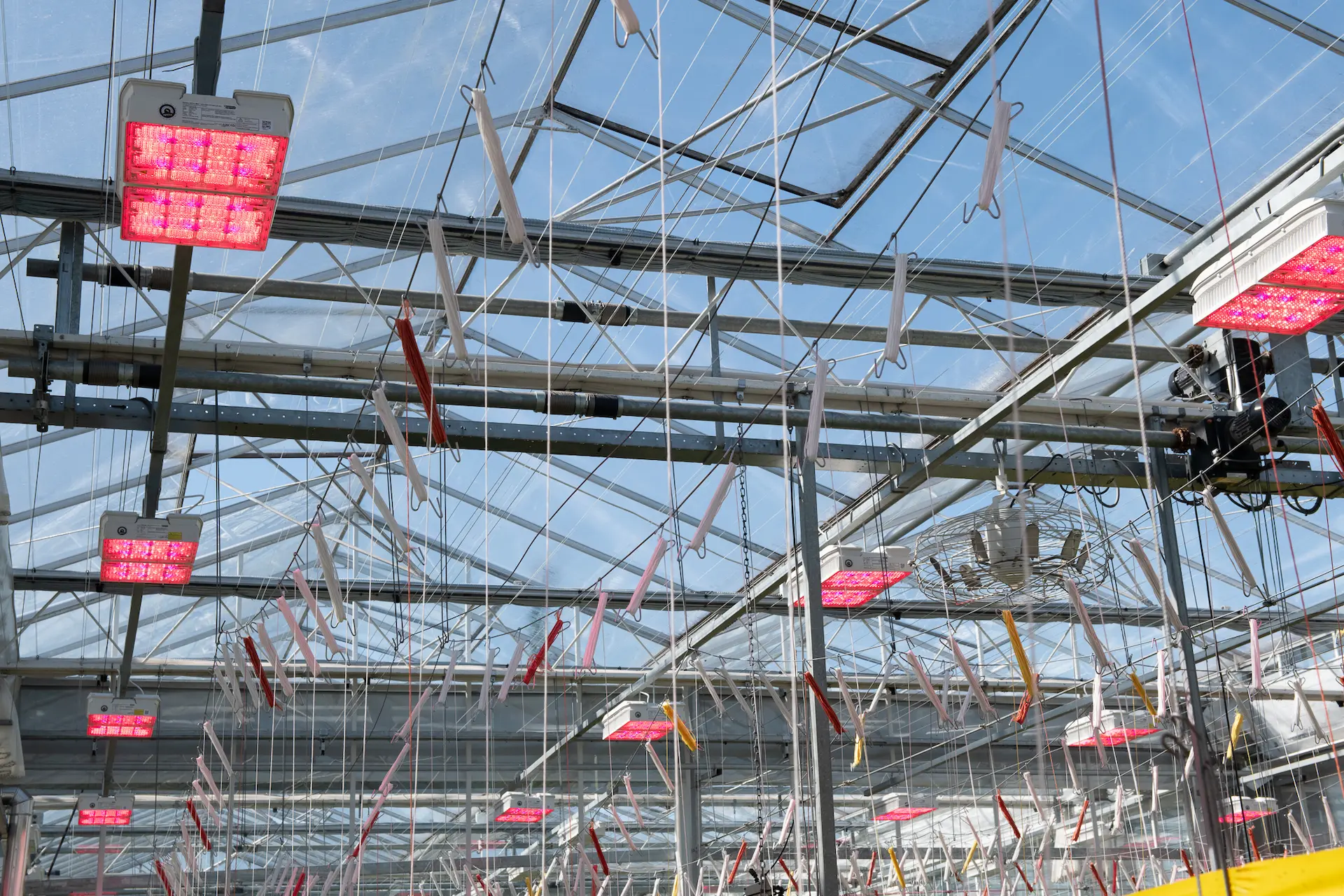
The timing of supplemental lighting affects how much light a crop can use and how well it turns that light into growth. In general, lights give the best return when natural daylight is low and the crop can still use extra light within its photoperiod (the daily light and dark pattern it needs). The right schedule depends on the crop, growth stage, season, greenhouse and energy prices. Below, we answer the most common questions about when to light, for how long, and how to control it.
Why does the timing of light change how plants respond?
Plants respond to the timing of light because photosynthesis, growth hormones and flowering signals all follow daily rhythms. The same amount of light can give different results depending on whether it arrives in the morning, at midday or during the dark period, and on how much daylight is already present.
Three effects explain most of this. First, photosynthesis levels off as light intensity rises. On a bright day, extra light from lamps adds little, while on a dull winter day the same lamps can add a lot. Second, plants have an internal clock that influences stomatal opening (the pores on the leaves), sugar transport and energy use, so light that fits this rhythm is generally used more effectively. Third, in photoperiod-sensitive crops, the length of the dark period can trigger or delay flowering, and light at the wrong moment can disturb this.
It also helps to know two terms. PPFD (photosynthetic photon flux density, in µmol/m²/s) is the light intensity at the crop at a given moment. DLI (daily light integral, in mol/m²/day) is the total light the crop receives over 24 hours. You can reach the same DLI with different timing, but the crop may not respond the same way to each pattern.
What is the best time of day to run supplemental lights?
The best time to run supplemental lights is usually when natural light is lowest compared with what the crop needs. This is typically early morning, late afternoon and evening, and on dark or overcast days. Lighting during bright midday hours generally adds the least value.
Growers often use lights to extend the day before sunrise and after sunset, which lengthens the effective photoperiod and raises the DLI. Others use lights to top up on dull days, switching them on when measured radiation falls below a set level and dimming or switching them off as daylight rises. Some crops and production systems also use lighting during the night period, which is common in northern regions in winter.
Night lighting needs extra care. Many crops benefit from a rest from light, and some varieties are sensitive to long photoperiods. Light escaping from the greenhouse at night may need to be limited with screens. Greenhouse climate matters too, because lamps change heat input and humidity. Heat from HPS and LED systems is distributed differently, which affects air movement and plant transpiration.
How should lighting timing differ between crops and growth stages?
Lighting timing should follow the crop’s photoperiod needs, its light demand and its growth stage. Fruiting crops, leafy greens, cut flowers and propagation material each respond differently, so one schedule is unlikely to suit every crop or cultivar.
Differences between crop types
Fruiting vegetables such as tomatoes and cucumbers often use long lighting periods in winter to build up the sugars needed for fruit production. Leafy greens usually do well with a defined photoperiod and a steady DLI that supports even growth. Strawberries respond to both the amount of light and the photoperiod, and the effect varies by cultivar and production system.
Photoperiod-sensitive ornamentals, such as chrysanthemums, need tighter control. Long-day and short-day treatments can decide whether plants stay vegetative or start to flower, so lighting and blackout schedules should match the crop plan.
Differences between growth stages
Young plants and propagation material often benefit from a consistent, controlled light period because they are small and cannot easily cope with swings in light supply. Established crops with a full canopy can use higher intensities and may tolerate more variation during the day. Vegetative and generative stages can also call for different light levels and durations.
Because targets vary by crop, cultivar, stage and growing conditions, we do not recommend copying a fixed schedule from another grower. Start from the biological needs of the crop, then adjust to your own greenhouse.
How does electricity pricing influence lighting schedules?
Electricity pricing influences lighting schedules by encouraging growers to run lamps during cheaper hours and reduce output during expensive ones, while still meeting the crop’s DLI and photoperiod needs. The aim is to shift or shape light use without compromising the crop.
Where energy prices change during the day, a grower may dim lights in peak-price hours and compensate with higher intensity when prices drop. It also makes sense to prioritise lighting on dark days, when each unit of electricity delivers the most useful light, and to reduce or skip lighting when natural light already meets the target.
There are limits. Light cannot be moved freely around the day if the crop needs a particular photoperiod or a dark period. Greenhouse climate also changes with lighting, so shifting hours may affect heating needs and humidity. The financial result depends on your installation, control strategy, crop requirements and local prices, so savings are not guaranteed. Total cost of ownership gives a more reliable picture than electricity cost alone.
How can growers fine-tune lighting timing with controls?
Growers can fine-tune lighting timing by linking lamps to a control system that responds to measured daylight, DLI targets, radiation forecasts and energy prices. This lets light intensity adjust automatically instead of following a fixed on and off schedule.
Light sensors measure natural radiation, so lamps add only what the crop still needs. Tracking the accumulated DLI shows how much light the crop has received so far and how much more is needed that day. Radiation forecasts help plan lighting ahead of sunny or cloudy periods, and energy price signals guide when to dim or raise intensity. Photoperiod limits, such as the earliest start, the latest stop and any required dark period, keep the schedule within what the crop can accept.
It helps to keep two terms apart. Dimming changes light intensity. Dynamic spectrum control changes the spectral composition of the light. They are related but separate functions, and not every luminaire or control system supports both. Check what your equipment can actually do before building a strategy around it.
Fine-tuning works best as a cycle: set a schedule, observe how the crop responds, review energy use and adjust. Greenhouse LED lighting with dynamic lighting control can make this easier, because intensity can change in small steps through the day.
How Agrolux helps with supplemental lighting timing
We help growers turn lighting timing into a practical plan that fits their crop, greenhouse and energy situation. We do not see it as a product choice. The right approach depends on location, natural light, greenhouse construction and height, crop, cultivation stage, existing technology, energy prices and climate.
Our support can include a lighting plan for your crop and site, light measurements and light distribution checks to see what your crop actually receives, and agronomic advice from our agronomists and plant scientists on the effects of light and spectrum. We assess LED and HPS lighting solutions together with your greenhouse climate and heat distribution. For control and energy management, we can help set up systems that adjust intensity based on daylight, energy prices and crop requirements, including our AgroluxOS development and wireless connectivity for large numbers of luminaires. Modular technology such as LYRA allows your system to change as your requirements evolve.
If you want to review your lighting schedule or plan a new installation, we are glad to talk through your crop and greenhouse with you. Visit the Agrolux homepage to contact our specialists, or see our portfolio for examples of greenhouse lighting projects.
Gerelateerde artikelen
- How can growers balance natural daylight and supplemental lighting?
- What Is PPFD and What Does It Tell You About Greenhouse Lighting?
- What should growers consider when upgrading an existing greenhouse lighting system?
- What is photon efficacy and why does it matter for greenhouse lighting?
- How often should greenhouse growers measure light levels?