


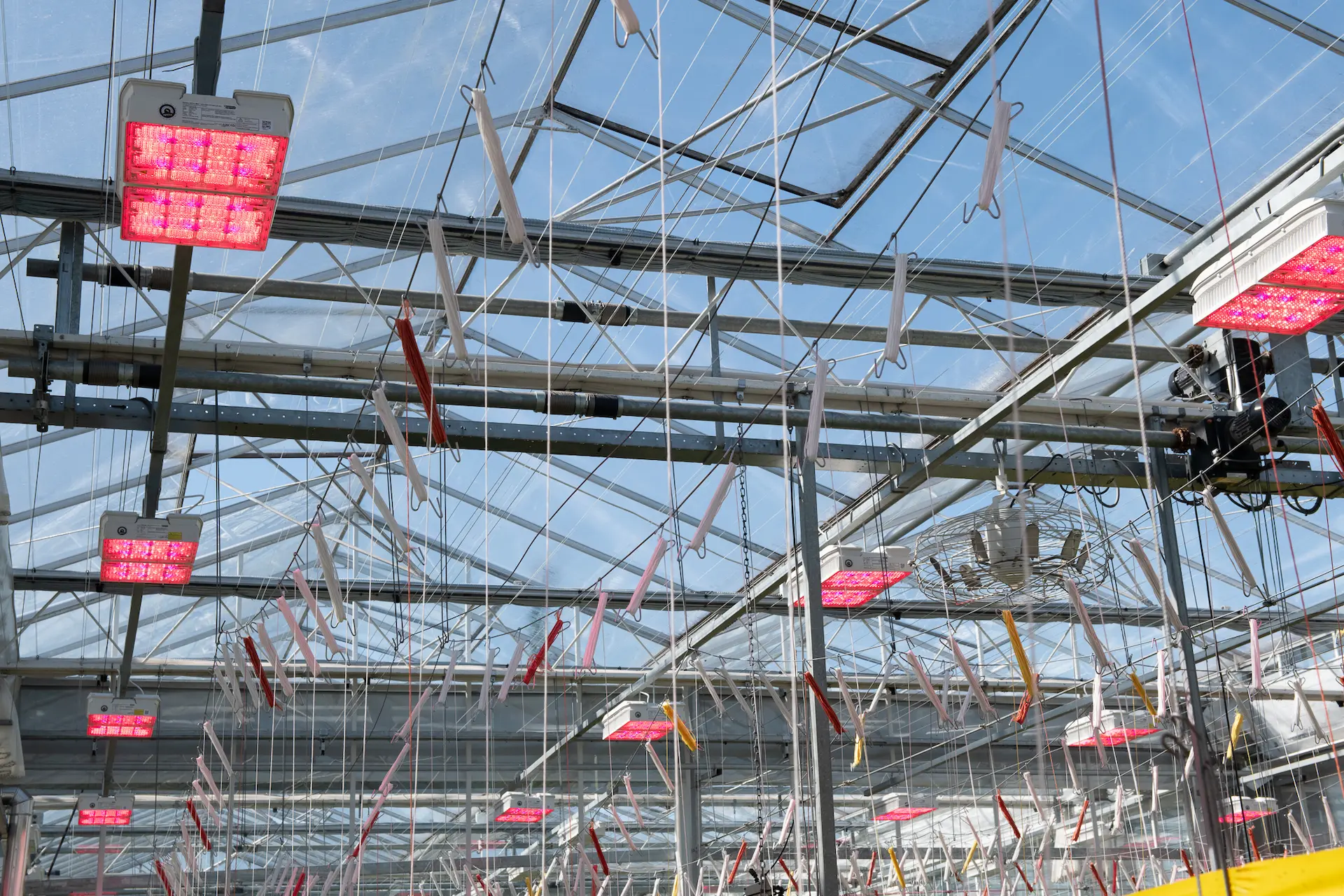
Most commercial greenhouses should take PPFD and light distribution measurements at least once a year and review continuous sensor data daily. Handheld spot checks are useful each season and after any change to lighting or glazing. The right schedule depends on your crop, your lighting installation and how much natural daylight your greenhouse receives.
Greenhouse light changes through the year, and so does the performance of your lamps and glass. Combining continuous monitoring with planned manual checks helps you notice changes before they affect the crop. The sections below cover the schedule, the events that call for extra measurements, what to measure, how to measure at canopy level and how to use the data.
What measurement schedule works for most commercial greenhouses?
A practical schedule has three layers: continuous sensor logging every day, manual PPFD spot checks each season, and full light mapping at least once a year. Together they show both the daily light your crop receives and slow changes in lamp output, glass transmission and canopy position.
Fixed sensors above the crop record outside radiation and light at crop level. Look at the daily light integral (DLI) trend every day, because it guides your lighting decisions. Every three to four months, take handheld PPFD readings at set grid points in representative compartments and compare them with earlier readings to spot drift. Once a year, ideally before the main lighting season starts, map the light in each compartment and calibrate your sensors at the same time.
Your own schedule may be tighter or looser. A propagation or leafy greens crop with tight light targets and short cycles benefits from more frequent checks than a long-cycle fruiting crop. Greenhouses with older lamps or a lot of dirt on the glass also need closer attention. Fixed sensors tend to drift over time, so calibration belongs in the schedule rather than being left to chance.
Which events call for extra light measurements?
Extra measurements make sense whenever something changes the light your crop receives. Common triggers are new or replaced luminaires, changes in crop height or planting layout, glass cleaning or coating, a change in lighting control strategy, and unexplained differences in crop development between compartments.
After an installation or retrofit, check that the delivered light matches the lighting plan before the crop goes in. After replacing lamps or drivers, measure again, because output can differ from the installed base, especially when old and new units are mixed. Glass washing, coating or screen changes alter how much natural light enters, which shifts how much supplemental light you need.
The crop itself also changes the picture. As plants grow closer to the lamps, light level and distribution at leaf level change. Uneven growth, colour or flowering can point to uneven light before it shows on any dashboard, so a measuring round is a useful first step when results vary. The same applies when you change the lighting strategy, for example dimming schedules, photoperiod or a switch between HPS and LED.
Seasonal shifts matter as well. Natural daylight in winter and summer differs widely by location, so the share of supplemental light you need changes too. A check at the turn of the season helps keep your targets realistic.
What should be measured: PAR, DLI or uniformity?
Ideally all three, because each answers a different question. PPFD tells you the light intensity at one moment, DLI tells you the total light your crop received over a day, and uniformity tells you how evenly that light is spread across the canopy.
PAR (photosynthetically active radiation) is the part of light, roughly 400 to 700 nm, that plants use for photosynthesis. PPFD (photosynthetic photon flux density) is the number of PAR photons reaching one square metre each second, measured in µmol/m²/s. It is the instantaneous reading. DLI (daily light integral) is the total PAR received over 24 hours, measured in mol/m²/day, and it adds up daylight and supplemental light together. Light uniformity describes how much PPFD varies across your measurement grid, often expressed as the ratio of the minimum to the average light level.
Target values differ by crop, variety, growth stage and growing conditions, so avoid copying numbers from another grower. Set your DLI targets with your crop advisor, then use measurements to see whether you reach them. Keep the photoperiod in mind too. You cannot freely move light from one part of the day to another, because the crop has biological needs for both light and dark periods.
Uniformity deserves attention because an average PPFD can hide dark and bright spots. With poor uniformity, part of the crop receives less light than planned while another part may receive more than it needs.
How should light be measured at canopy level?
Measure at the top of the crop canopy with a calibrated quantum sensor held level and facing upward, at fixed grid points you can return to each time. Consistent position, height and timing matter more than any single reading.
Start by defining a grid across the compartment, including edges, corners and areas under gutters or structures, and mark the points so you can find them again. Use a quantum sensor with a recent calibration date. Some sensors read differently under LED and HPS light, so confirm that yours suits your lamps. Take readings at the top of the canopy rather than at floor level, and adjust the height as the crop grows.
To check lamp performance, measure at night or with screens closed, because daylight otherwise masks the contribution of the luminaires. Write down the time, dimming level, screen position and outside conditions with each round.
Keep your own shadow off the sensor and hold it level, since small tilts can shift the reading noticeably. For fixed sensors, install them at representative positions and keep the lens clean, because dust and condensation reduce the reading.
How can light data be logged and used for decisions?
Log every reading with its location, date, time and conditions, then compare it with your lighting plan and earlier measurements. This turns single readings into a trend that shows drift, supports dimming decisions and helps explain differences in crop performance.
Comparing accumulated DLI with your crop’s target shows when daylight falls short or exceeds expectations, so you can adjust supplemental lighting. A slow decline in PPFD at the same grid point can show when a lamp, driver or fixture needs attention. Light measurements, radiation forecasts, DLI targets, photoperiod and electricity prices together can inform when to dim or switch off supplemental light, although not every control system supports every function. It is worth checking what yours can do.
Overlaying light maps with crop observations can show whether uneven growth follows uneven light. Documented measurements also let you compare the installed performance with the original lighting plan.
A simple spreadsheet works for manual readings. For continuous sensor data, a climate computer or lighting control platform that stores history makes trends easier to read. Choose a format you will actually keep up with.
How Agrolux helps with greenhouse light measurement
We see light measurement as part of a lighting plan that fits your crop, greenhouse and location, not as a stand-alone task. Our specialists combine lighting design, light measurements and agronomic knowledge to help you set targets and check whether your installation delivers them.
In practice, this can include lighting plans that take crop, greenhouse height, natural light and existing technology into account, as well as light measurements and distribution checks at canopy level. Our agronomists and plant scientists can advise on how light and spectrum relate to your crop and growth stage. Where it fits your situation, we also offer LED and HPS lighting, including our modular LYRA LED platform, and support with lighting control and energy management based on daylight, crop requirements and energy conditions.
If you want to review how often and how well you measure light in your greenhouse, we are happy to talk it through. Visit the Agrolux homepage to get in touch with our specialists, or browse our project portfolio to see how we approach different greenhouse situations.
Gerelateerde artikelen
- How does greenhouse lighting affect photosynthesis throughout the day?
- How can growers adapt greenhouse lighting during cloudy weather?
- How can greenhouse growers compare the efficiency of different lighting systems?
- What is photon efficacy and why does it matter for greenhouse lighting?
- How does greenhouse lighting influence CO₂ uptake and photosynthesis?