


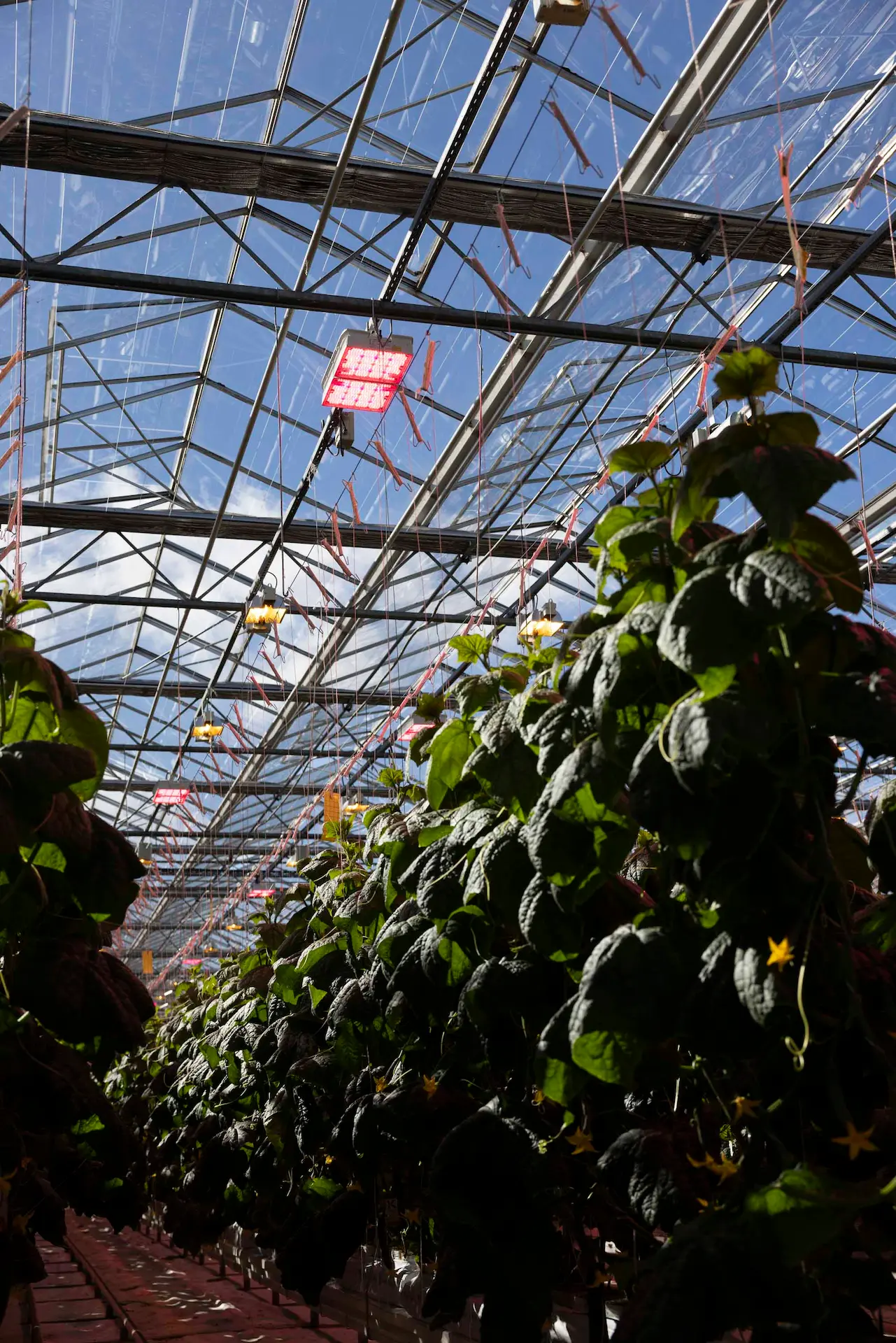
Dimmable lighting is one of the key elements of a dynamic lighting strategy. By automatically adjusting light output based on real-time lighting conditions, crop needs, and energy pricing signals, growers can make more efficient use of supplemental lighting. Instead of running at a fixed intensity all day, dynamic lighting systems adjust light output in response to natural daylight, target light sums, and tariff schedules. In this article, we focus on the dimming aspect of dynamic lighting. The use of dynamically adjustable light spectra is a separate topic and will be covered in a dedicated article.
What types of energy savings does dynamic lighting deliver in greenhouses?
Dimmable lighting delivers energy savings by reducing light output whenever natural daylight is sufficient, avoiding unnecessary electricity consumption during periods of low crop light requirements, and responding to grid pricing signals to shift energy use away from expensive periods. Across a full growing season, this combination can meaningfully reduce total electricity consumption compared to fixed-output systems.
The savings come from several distinct mechanisms working together. First, daylight integration means the system dims or switches off the artificial lighting when natural daylight already provides sufficient light inside the greenhouse. Second, target-based control ensures the crop receives its target daily light integral (DLI) while respecting the required photoperiod. Rather than running at full output throughout the entire lighting period, the system can adjust light intensity based on the contribution from natural daylight. Third, the system can take electricity prices into account, reducing lighting levels during expensive periods and making use of lower-cost electricity when agronomically possible, while still maintaining the DLI.
Together, these mechanisms help growers use energy more efficiently and reduce lighting costs. Rather than running at full output according to a fixed schedule, the system adjusts lighting to actual crop requirements and natural light conditions. When implemented correctly, this can deliver significant energy savings while maintaining crop performance.
How does dynamic lighting respond to natural daylight in real time?
Dynamic lighting responds to natural daylight in real time by reading data from daylight sensors and automatically adjusting luminaire output to maintain a consistent total light level at crop level. When solar radiation increases, the system dims artificial lighting proportionally; when clouds reduce natural light, it compensates by increasing output.
This process relies on a control system that continuously compares the measured natural light contribution against a target setpoint. The setpoint is typically defined as a target intensity at canopy level, expressed in micromoles per square meter per second (µmol/m²/s). It calculates the gap between what the sun is currently delivering and what the crop requires, then instructs the luminaires to fill that gap while maintaining the configured photoperiod.
The speed of response matters. A well-designed dynamic system reacts within seconds to changing cloud cover, preventing both over-lighting on bright days and under-lighting during rapid weather changes. This real-time responsiveness is what distinguishes dynamic lighting from simple time-clock or sunrise/sunset scheduling, which cannot account for variable cloud conditions or seasonal shifts in solar angle and intensity.
While dynamic lighting is most commonly associated with adjusting light intensity, some modern LED systems can also dynamically adjust the light spectrum. This creates additional opportunities to influence crop development, product quality and energy use. Because spectrum management involves different agronomic considerations, we will explore this topic in more detail in a separate article.
What role does the daily light integral play in dynamic lighting strategies?
The daily light integral (DLI) is the total amount of photosynthetically active radiation a crop receives over a full day, measured in mol/m²/day.
In dynamic lighting strategies, DLI is often one of the primary control targets. The system tracks how much light has accumulated throughout the day and adjusts artificial output accordingly, while ensuring that photoperiod requirements are respected. Many advanced control systems also make use of weather and radiation forecasts, allowing them to anticipate how much natural light is expected later in the day and adapt the lighting strategy accordingly.
Using DLI as the control target rather than fixed hours or fixed intensity is a more crop-accurate approach. Different crops have different DLI requirements. Tomatoes and cucumbers typically need high daily light sums to support fruit load, while leafy greens and propagation crops often require lower targets. By programming the system to achieve a specific target DLI while maintaining the required photoperiod, growers ensure that lighting decisions are aligned with the crop’s actual needs.
Practically, this means that on a bright sunny day, the artificial lighting may run for only a few hours or not at all, because the sun has already delivered, or is expected to deliver, most or all of the target DLI. On overcast winter days, the system runs longer and at higher intensity to compensate. This flexibility prevents unnecessary lighting during bright conditions while ensuring crops receive sufficient light on darker days, automatically optimizing energy use around what nature provides.
How can dynamic lighting reduce electricity costs during peak tariff periods?
In markets where electricity is priced dynamically, such as day-ahead spot markets common in parts of Europe, the difference between peak and off-peak tariffs can be substantial. A control system that can read price signals and act on them allows growers to treat their crop lighting as a flexible asset. During high-price hours, the system can reduce lighting levels where agronomically possible. By increasing the light intensity during lower-cost periods, the crop’s DLI and photoperiod requirements will still be met.
This approach requires careful calibration. Not all crops tolerate large shifts in lighting strategy, and the required DLI must still be achieved within the crop’s photoperiod requirements. However, when implemented correctly, tariff-responsive dimmable lighting can reduce the effective cost per mole of light delivered, improving the economics of supplemental lighting without compromising crop performance.
What’s the difference between dimmable lighting and traditional fixed-output lighting?
The core difference between dimmable lighting and traditional fixed-output lighting is that traditional systems typically operate using on/off control, based on fixed schedules and radiation thresholds, while dimmable systems continuously adjust output based on natural light levels, accumulated DLI, and energy pricing. This allows the lighting system to make better use of available daylight and more closely match light output to the crop’s requirements and outside conditions. Rather than switching between full output and off, the system can continuously adjust light levels to supplement only what is needed.
Dimmable lighting replaces this traditional on/off approach with a responsive control strategy. The comparison below illustrates the practical differences:
- Response to sunlight: Traditional lighting switches on or off when predefined thresholds are reached; dynamic lighting gradually adjusts output as natural light conditions change.
- Energy consumption: Traditional lighting is relatively simple and predictable; dynamic lighting more closely matches energy use to actual crop requirements.
- Tariff responsiveness: Traditional lighting typically does not respond to electricity prices; dynamic lighting can incorporate energy pricing into the control strategy.
- DLI management: Traditional lighting relies on fixed schedules and switching thresholds; dynamic lighting continuously adjusts output based on accumulated DLI, changing daylight conditions, and radiation forecasts to reach the target more accurately.
The trade-off is complexity. Dynamic lighting requires more sophisticated control hardware, reliable sensor inputs, and a correctly configured strategy. However, for professional greenhouse operations where energy is a major operating cost, the additional complexity typically delivers a clear return. Also, most of the complexity operates in the background, allowing growers to focus on crop management while the system continuously optimizes the lighting strategy.
Which greenhouse crops benefit most from dynamic lighting control?
Crops that benefit most from dynamic lighting control are those grown year-round under supplemental lighting in high-energy-cost environments, particularly fruiting vegetables such as tomatoes and cucumbers, and high-value crops like cut flowers and soft fruits. These crops have well-defined DLI targets, long production cycles, high product quality demand and high sensitivity to light sum consistency, making precise control both practical and valuable.
Tomatoes and cucumbers are among the most responsive crops because their yield, fruit quality, and plant balance are strongly influenced by accumulated light. Dynamic dimming helps growers maintain a more consistent DLI across variable weather conditions, stabilizing production and reducing the risk of light-related stress.
Leafy greens and herbs also benefit from dynamic lighting, as a consistent daily light sum supports uniform growth, crop quality, and efficient energy use.
Cut flowers, potted plants, and propagation crops often have strict photoperiod and DLI requirements. For many ornamental crops, precise daylength control is essential for flowering and uniformity, while propagation crops benefit from a carefully managed light sum that supports strong plant development without exposing young plants to unnecessarily high light levels.
How Agrolux helps with dynamic lighting and greenhouse energy management
We work with professional greenhouse growers to develop lighting strategies that go beyond selecting a luminaire. Our approach combines agronomic knowledge with intelligent control technology, so your lighting system actively contributes to energy efficiency rather than simply providing light.
- Crop-specific lighting design: We help define the right light levels, daily light sums, and photoperiods for your crop, production goals, and greenhouse environment.
- AgroluxOS intelligence: Combines real-time light measurements, radiation forecasts, and electricity pricing data to continuously optimize lighting throughout the day.
- HortiMesh wireless connectivity: Connects luminaires and sensors without complex cabling, simplifying installation and communication across large greenhouse compartments.
- LED and HPS compatibility: Works with LED, HPS, and hybrid installations, allowing existing and new systems to benefit from advanced lighting management.
- Scalable implementation: Designed to support both small and large projects, with the flexibility to expand as your operation grows.
If you want to understand how dynamic lighting could reduce energy costs in your specific greenhouse, we encourage you to speak with our specialists about your crop, your current lighting setup, and your energy situation. Visit agrolux.com to get in touch, or explore our lighting portfolio to see the solutions we work with.