


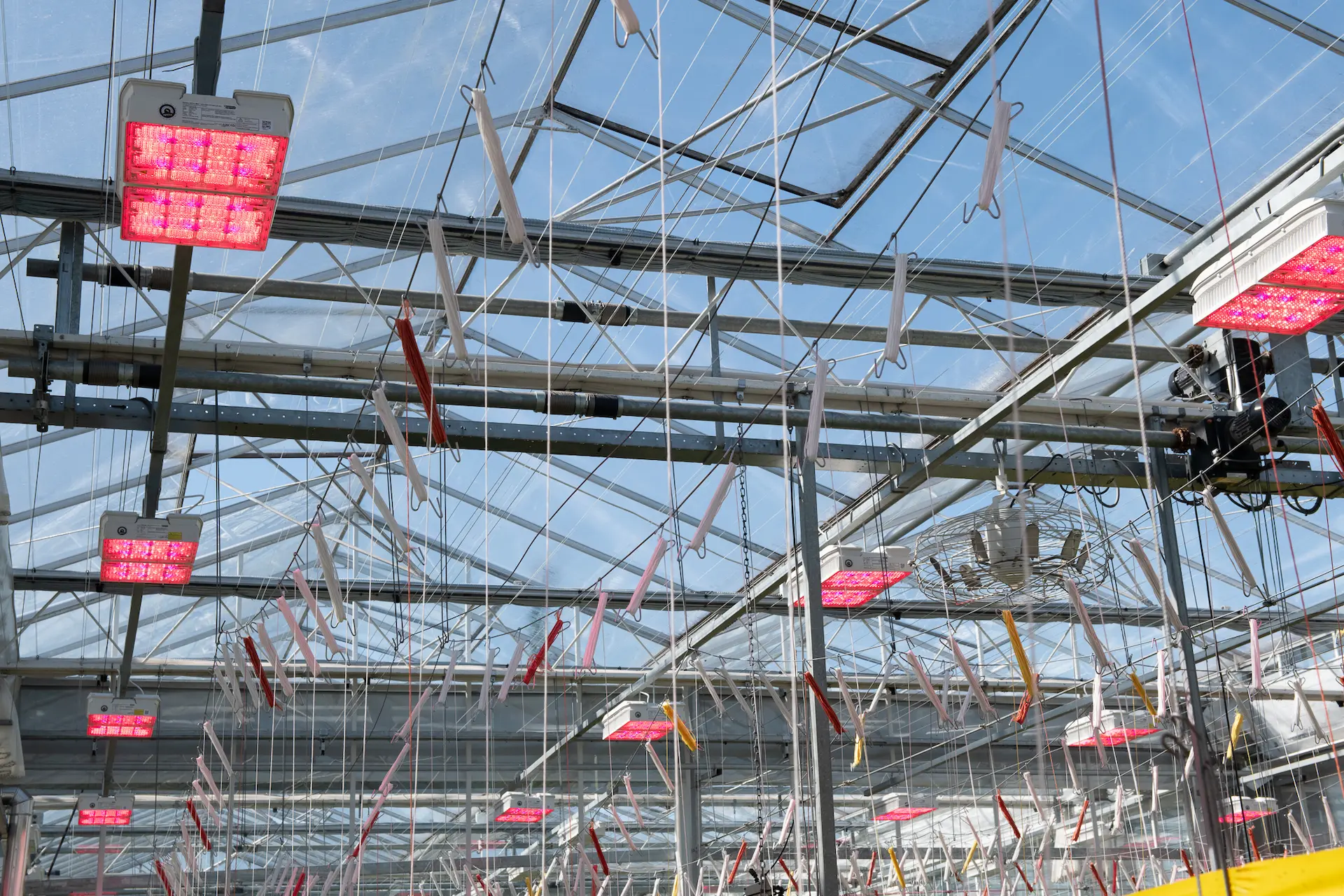
Growers adapt greenhouse lighting during cloudy weather by measuring the daylight that actually reaches the crop, then adding supplemental light only to close the gap to the crop’s daily target. Dimming, forecast-based control and automation can help match light output to conditions without wasting energy.
The right approach depends on the crop, its growth stage, the greenhouse structure, the photoperiod and electricity prices. The sections below explain how much light you lose, how to calculate what to add, and how to control it.
How much natural light is lost on cloudy days?
Cloudy days reduce the light reaching your crop, but the loss varies widely with cloud thickness, season, location and greenhouse construction. A thin overcast may cut light moderately, while dense winter cloud can cut it sharply. Measure the light inside your greenhouse rather than relying on a general figure.
Clouds do more than dim the light. They also scatter it. Diffuse light spreads more evenly through the canopy, which can reduce harsh shadows and bring more light to the lower leaves. This may partly offset the lower total.
Several factors shape what the crop receives. Low winter sun already delivers less light before clouds arrive. Glass type, coatings, roof bars, screens and the age of the glazing all affect how much light passes through. A tall, dense crop also intercepts light differently from young plants or propagation material. Dirty roofs and wet glazing lower transmission further.
Light sensors above the crop show you the real situation and are the basis for every decision that follows.
How do you calculate the supplemental light needed?
You calculate supplemental light by comparing your crop’s target daily light integral (DLI) with the daylight DLI measured in the greenhouse. Lighting then supplies the difference. The target depends on the crop, cultivar, growth stage and production goals, so set it with your agronomist or crop advisor.
It helps to separate two measures. PPFD (photosynthetic photon flux density) is the light intensity reaching a square metre at a given moment, in µmol/m²/s. DLI is the total amount of photosynthetically active radiation received over 24 hours, in mol/m²/day. PAR is the range of light, roughly 400 to 700 nm, that plants use for photosynthesis. PPFD and DLI show how much of it arrives, either per second or per day.
A practical calculation follows these steps:
- Set the DLI target for the crop and growth stage.
- Measure or forecast the daylight DLI inside the greenhouse, after glass and screen losses.
- Subtract the daylight DLI from the target to find the shortfall.
- Convert the shortfall into lighting intensity and hours, using the installed PPFD at crop level.
- Check the result against the crop’s photoperiod limits.
Photoperiod matters. You cannot always extend the lighting hours to make up a deficit, because some crops respond to day length and need a dark period. Light measurements at crop level, not just fixture ratings, make this calculation more reliable.
Should lighting be dimmed or switched on and off?
Dimming usually gives smoother control than switching on and off, because it adjusts output to the daylight available. Switching suits simple installations or luminaires without dimming capability. The right choice depends on the lighting technology, the control system and how closely you want to follow the daylight.
Dimmable lighting changes light intensity based on daylight, crop requirements, accumulated DLI or energy conditions. With dimmable LED grow lights, you can top up the light in small steps as clouds pass. This keeps the crop closer to its target and avoids sudden swings in light level.
Switching works in blocks. It is simple and robust, but it delivers light in larger steps. HPS fixtures, for example, are typically controlled by switching groups or by stepped dimming, depending on the system. Not every control system supports every function, so check what your luminaires, drivers and controller can do before planning a dynamic strategy.
Heat also plays a role. HPS and LED distribute heat differently, which affects air movement, transpiration and the greenhouse climate. When you dim or switch, you change both light and heat input, so coordinate lighting with your climate control.
Does light spectrum matter under overcast skies?
Spectrum can matter, but on cloudy days intensity usually has the larger effect. Overcast skies shift the daylight spectrum slightly and reduce its total, so the first priority is closing the DLI gap. Spectrum is a finer adjustment that depends on the crop and cultivar.
Dimming changes light intensity. Dynamic spectrum control changes the spectral composition of the light. They are different tools, and not every system offers the second.
Some growers use blue, red or far-red light to influence plant shape, leaf size or development. Far-red effects vary between crops and growing conditions, so treat them with care and test on a small area first. No spectrum suits every crop, and research on spectra is still developing, including in crops such as strawberry.
For low-light greenhouse crops, start with the intensity and photoperiod your crop needs. Then fine-tune the spectrum with agronomic advice, based on your cultivar and production goals.
How can growers control lighting costs in dull weather?
You can control lighting costs by lighting only when and where the crop needs it, using daylight measurements, DLI targets and electricity prices to guide your decisions. Results depend on your installation, control strategy, crop and energy market, so savings cannot be guaranteed.
Daylight-based dimming supplies only the light the crop is missing instead of running at full output. Tracking accumulated DLI lets you stop adding light once the daily target is met. Where your energy contract allows, you can shift lighting towards lower-price periods, as long as the crop’s photoperiod needs are respected. Radiation forecasts help you plan the day ahead rather than react hour by hour. It is also worth reviewing the photon efficacy, light distribution and maintenance of your current fixtures.
A hybrid setup of HPS and LED can also help. HPS adds heat that some greenhouses use in cool, dull weather, while LED offers fine dimming control. Whether a hybrid makes sense depends on heating costs, climate and investment. LED is not automatically the better choice in every greenhouse.
Total cost of ownership is wider than electricity alone. Consider investment, maintenance, heat balance and crop response together.
What is the best way to automate light adjustments?
A good way to automate light adjustments is to connect dimmable luminaires to a control system that reads daylight sensors, applies DLI targets and respects photoperiod limits. Add radiation forecasts and electricity prices where available. Greenhouse lighting automation works best when it is linked with your climate control.
A well-set automation strategy usually includes:
- Sensors: Light sensors that measure daylight at representative points in the greenhouse.
- Targets: Crop-specific DLI and photoperiod settings, adjusted by growth stage.
- Control logic: Rules that dim or switch based on daylight, accumulated DLI and price signals.
- Connectivity: Reliable communication between controller and luminaires, whether wired or wireless.
- Integration: Coordination with screens, heating and ventilation so light and climate work together.
Start simple and expand step by step. Review logged data regularly, compare the results with crop performance, and adjust the strategy as seasons and crop stages change. Adaptive greenhouse lighting should support your cultivation decisions, not replace them.
How Agrolux helps with lighting in cloudy weather
At Agrolux, we see light management as part of the whole cultivation environment. No single luminaire suits every grower, so we start with your greenhouse, crop, location, existing technology and energy situation.
Our specialists can help with greenhouse-specific lighting plans, light measurements at crop level, and agronomic advice on how light and spectrum may affect your crop. We can also discuss LED and HPS options that suit your climate, heat balance and investment plans. Where dynamic lighting is relevant, we can look at control and energy management that responds to daylight, crop requirements and energy prices, supported by AgroluxOS and wireless connectivity. Modular systems such as LYRA can be expanded as your requirements change.
If you want to review how your lighting performs on dull days, talk to our specialists about your greenhouse, crop and energy challenges. You can visit the Agrolux homepage to get in touch, or see our portfolio for examples of greenhouse lighting projects.
Gerelateerde artikelen
- How do greenhouse lighting controls respond to changes in daylight?
- What is photon efficacy and why does it matter for greenhouse lighting?
- How often should greenhouse growers measure light levels?
- What is the difference between measuring light above and within the crop canopy?
- How does greenhouse lighting influence CO₂ uptake and photosynthesis?