
What is light?
Light is electromagnetic radiation, a form of radiant energy that propagates through space in the form of waves. The radiant energy associated with these waves exists in small energy packets known as photons. The amount of energy per photon depends on the wavelength; shorter wavelengths correspond to higher energy content per photon. This implies that blue light (400-500 nm) contains more energy per photon than red light (600-700 nm). Both the sun and artificial lamps emit electromagnetic radiation. The sun’s radiation is filtered by the atmosphere and then reaches the Earth as global radiation. This radiation encompasses wavelengths between 300-3000 nm (see the figure below). Light within the wavelength range of 380-780 nm is perceptible to the human eye and is termed (visible) light. Plants can utilize radiation with wavelengths between 400 and 700 nm for photosynthesis. Radiation between 700 and 800 nm is referred to as far-red light, which primarily serves as a regulatory factor for plant processes.
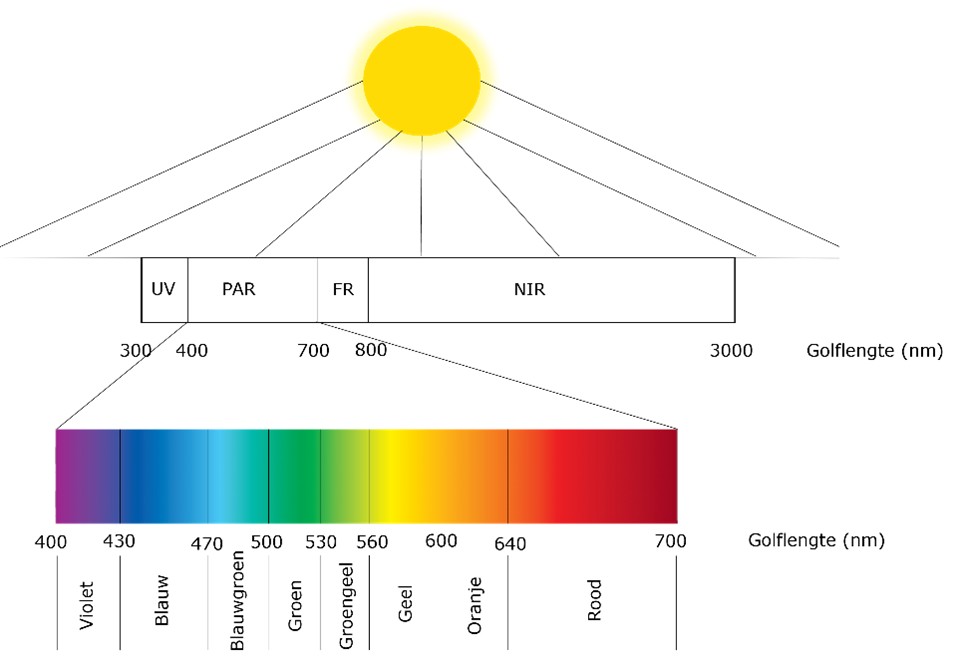
Figure spectral distribution of global radiation.
Spectral distribution of sunlight, with a detailed subdivision of colors in the PAR light.
Light influences the growth and development of plants in various ways, specifically through quantity (intensity and daily light integral), quality (light color/light spectrum, direction) and photoperiod. The photoperiod, also known as day length, represents the duration within a day (24 hours) that the plant receives light. When deciding on assimilation lighting and formulating a lighting strategy, it is essential to consider these three light characteristics.

From: Janneke Grit & Anja Dieleman | Illuminating Growth: Assessing the Impact of LED Lighting on Greenhouse Cultivation

