
Light - terminology
When discussing light, various terms are commonly used, such as PAR, PPFD, and DLI. Below, we explain what they mean.
PAR
PAR stands for photosynthetic active radiation, which refers to radiation that can be utilized for photosynthesis. Plants can only use specific wavelengths of light for photosynthesis, namely those within the range of 400 to 700 nm. This includes blue light (400 – 500 nm), green light (500 – 600 nm), and red light (600 – 700 nm).
PPF and PPFD
PPF stands for Photosynthetic Photon Flux, representing the quantity of photons in the PAR region of light. It is used to indicate the amount of light emitted by a light source per second, measured in µmol/s. To determine the light received by a plant, the photon flux density in the PAR spectrum must be assessed. This is the Photosynthetic Photon Flux Density (PPFD), denoting the amount of photosynthetically active photons per square meter per second. The unit of PPFD is µmol/m2/s.
DLI
The total amount of PAR light a crop receives in a day is also referred to as the daily light integral (DLI). DLI is measured in mol/m2/day. You can calculate DLI by multiplying the PPFD by the day length (and adjusting for units). For example, if a lamp emits 100 µmol/m2/s and is on for 12 hours, the DLI would be: 100 * 12 * 3600 / 1000000 = 4.32 mol/m2/day.
Light units
Various units are used to express the quantity of light, such as µmol/m2/s, W/m2, or Lux. While it is relatively straightforward to convert a quantity like distance between different units, the same is more complex for light. In the next paragraphs, we explain the units, how to convert between them, and why certain units are not recommended in horticulture.
Joule
Joule (J) is the unit of energy, and Watt (J/s) is the unit of power (energy per unit time). In (assimilation) lighting and natural radiation, these units indicate how much energy the photons from a light source carry. This allows the calculation of their impact on the greenhouse’s energy balance. The energy content per photon depends on the wavelength; shorter wavelengths have a higher energy content per photon. For example, the energy content of a 400 nm photon (blue) is 1.75 times higher than that of a 700 nm photon (red). Joule and Watt are therefore units used to represent influences on the energy balance of the greenhouse and the plant.
Mol
The unit Joule is not suitable for determining the potential for photosynthesis. Plant photosynthesis is not related to the energy content of radiation but to the number of photons absorbed by chlorophyll. Therefore, the unit µmol/m2/s is used for the portion of light used by plants for photosynthesis (PAR light, 400-700 nm). µmol/m2/s is the unit used in horticulture to express the total available light (artificial and natural) for growth.
Lux
Then there are units like lumen and lux (lumen/m2). Historically, most light sources were developed for the human eye, using units such as lumen and lux. However, the sensitivity of the human eye to light differs significantly from the efficiency with which plants use different light colors for photosynthesis (see the figure below). The human eye is particularly sensitive to the green-yellow part of the light spectrum, while that part of the spectrum is least absorbed by plants. The lumen unit is based on the sensitivity of the human eye. When using lux to quantify the amount of lamp light, you will measure a much lower amount of lux at the same intensity under red and blue LEDs compared to HPS lamps, which peak in yellow light. Light flux measured in lux and lumen therefore does not accurately represent the extent to which a plant can utilize different light colors for photosynthesis. The use of lumen and lux should be avoided in horticulture.
Unit conversion
Light units can be converted into each other, but the conversion factor strongly depends on the spectrum of the light source. Note: conversion factors for different lamp types can vary significantly.
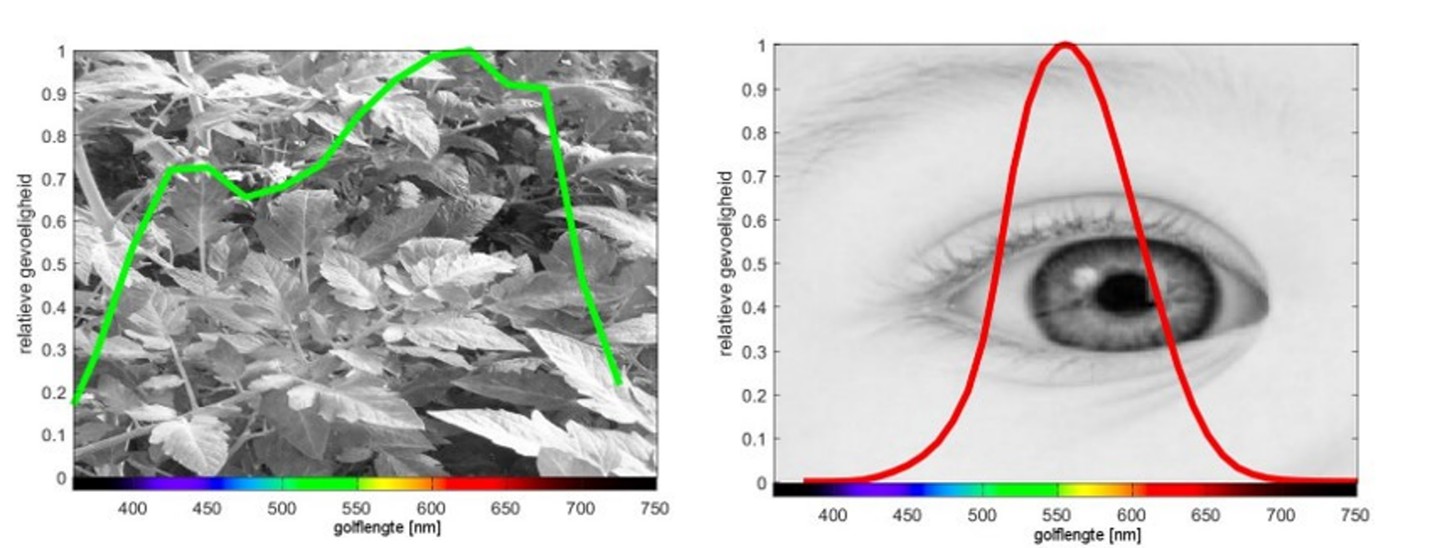
Figure Sensitivity to light spectrum
The sensitivity of plant photosynthesis to light of different wavelengths (left) and the sensitivity of the human eye to the light spectrum (right)

From: Janneke Grit & Anja Dieleman | Illuminating Growth: Assessing the Impact of LED Lighting on Greenhouse Cultivation

