


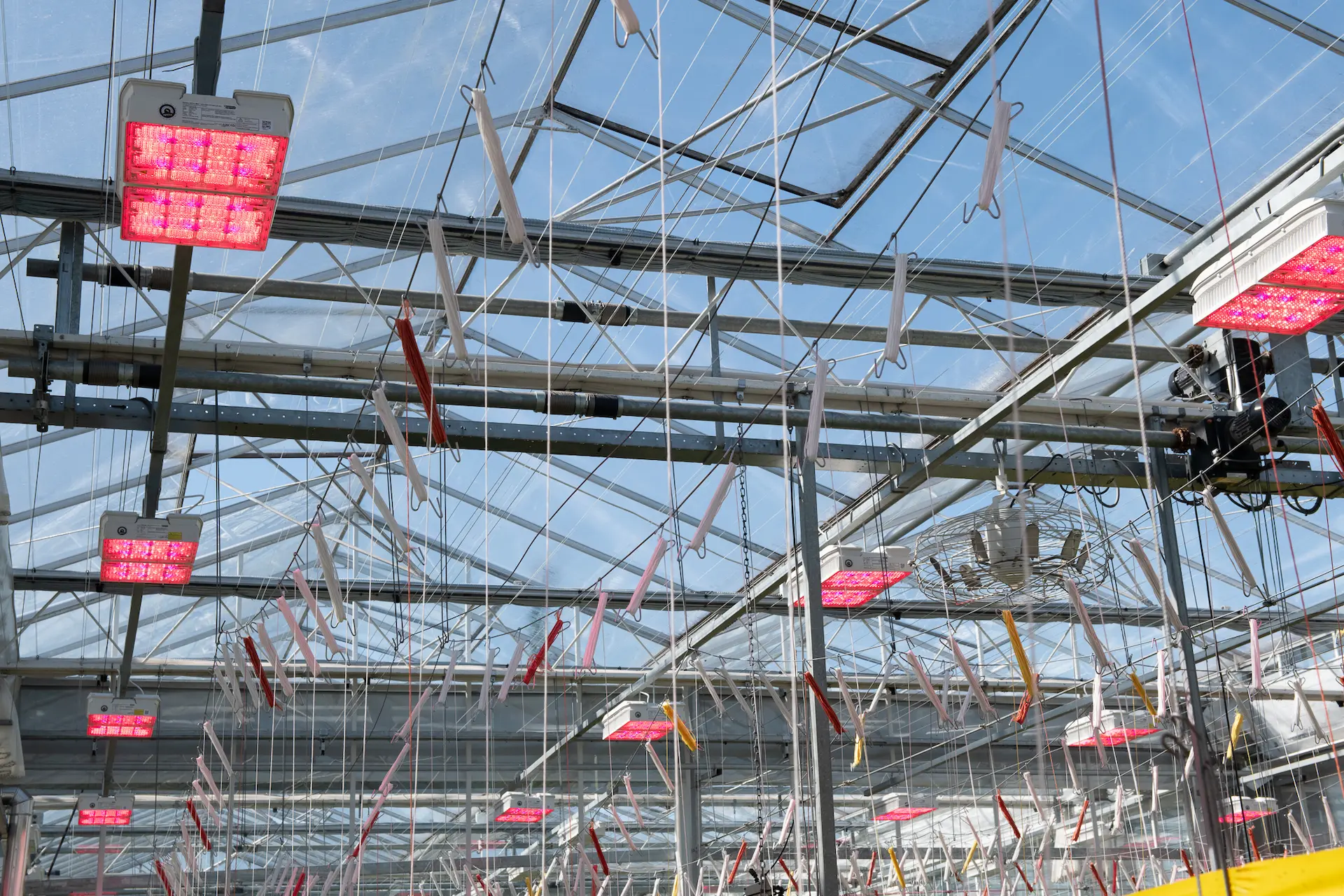
Where you place your luminaires affects how evenly light reaches the crop, how much natural daylight is lost to shading, and how much electricity you use to reach your light targets. Mounting height, spacing and orientation work together. They shape how light is spread across the canopy and the PPFD (the amount of light reaching one square metre of crop each second) that each plant receives.
The right layout depends on your crop, greenhouse structure, daylight levels and light source. This article answers six common questions about luminaire placement in a greenhouse, from the causes of uneven light to how to check a lighting layout once it is installed.
What causes uneven light distribution in greenhouses?
Uneven light in a greenhouse is mainly caused by luminaire spacing that does not match the beam pattern, the mounting height, the crop structure and the greenhouse construction. Edges, gutters, walls and structural elements also change how much light reaches each part of the crop.
Every luminaire has its own light distribution pattern. Light is strongest directly below the fixture and fades towards the sides. If neighbouring luminaires overlap too little, you get bright zones under each fixture and darker zones in between. In the crop, this can show up as differences in growth, ripening or quality across a compartment.
Several other factors play a role. Near the walls and edges, fewer luminaires contribute light, so the outer rows often receive less. A tall, dense crop such as tomato or cucumber absorbs and reflects light differently from a low crop such as lettuce or young plants in a propagation tray. Trusses, pipes, screens and cables can partly block light, and the floor covering, wall material and leaf colour influence how much light is reflected back into the canopy. Dirt on the luminaires and a gradual drop in output over time can also reduce the light that reaches the crop.
A good lighting plan takes these factors into account before installation, rather than trying to correct them afterwards.
How high should luminaires be mounted above the crop?
The right mounting height is the distance that gives the light uniformity you need at canopy level without overheating the crop or wasting light on the surrounding structure. There is no single correct figure, because it depends on the beam angle of the luminaire, the height of the crop and the greenhouse construction.
Mounting height has two main effects. A greater distance between luminaire and crop lets the light from neighbouring fixtures overlap more, which generally improves greenhouse light uniformity. However, the light also has to travel further, and more of it can be lost to the sides or onto structures. A lower position puts more light directly on the crop, but it makes an even distribution harder to achieve.
The choice also depends on the crop and the equipment. Upright crops such as tomatoes and cucumbers grow closer to the lamps during the season. HPS and LED luminaires give off and spread heat differently, which affects how close you can place them to the plants. Narrow and wide beam patterns need different heights to reach the same overlap, and gutter height, truss design and screen systems limit where fixtures can be mounted.
Because the crop keeps growing, the distance between lamp and canopy changes through the season. Your layout should work for the crop at its tallest, not only at planting.
How does luminaire spacing change light uniformity?
Closer spacing generally improves light uniformity, because the beams of neighbouring luminaires overlap more and smooth out the difference between bright and dark areas. Wider spacing means fewer fixtures but more variation across the canopy, unless the optics and mounting height are matched to it.
Spacing and height are linked. A higher mounting position allows wider spacing for the same uniformity, while a lower position needs fixtures closer together. The aim is to find the balance that delivers the PPFD your crop needs with an acceptable variation across the compartment.
Spacing also involves a trade-off with installed capacity. More luminaires with a lower output each can give a more even distribution, while fewer luminaires with a higher output reduce the number of fixtures and installation points. Which option suits you depends on investment cost, how sensitive your crop is to differences in light, and your greenhouse LED lighting design or HPS layout.
It helps to remember that PPFD and DLI describe different things. PPFD is the light intensity at a single moment and place. DLI is the total amount of light the crop receives over a day, measured in mol/m²/day. A layout can reach the right average PPFD and still leave some areas with a lower DLI if the uniformity is poor.
Can luminaire placement block natural sunlight?
Yes. Luminaires, their mounting structures and cabling cast shadows on the crop and reduce the natural daylight that reaches the canopy. The effect depends on the size, number and position of the fixtures, and it matters most in regions and seasons with limited daylight.
This is an important point for supplemental lighting in greenhouses, where daylight remains the main light source for much of the year. Every structure above the crop takes away some sunlight, including on bright days when you do not need artificial light at all.
You can limit this effect in several ways. Slimmer fixtures block less sunlight than bulky ones. The direction of fixtures and mounting structures relative to the roof ridge and the path of the sun changes the shadow pattern, as does the choice between fewer, larger luminaires and many smaller ones. Cabling and supports add to the shading too, so their routing deserves attention. Local conditions matter as well: a site with bright winter light is affected differently from one with long periods of low light.
The right balance depends on how much of your annual light comes from the sun and how much from the luminaires. A lighting plan should weigh the light the installation adds against the daylight it may take away.
How does placement affect energy efficiency and operating costs?
Placement affects energy efficiency because it determines how much of the emitted light actually reaches the crop and how evenly it is spread. Light that falls on paths, walls or gaps between rows uses energy without benefiting the crop. Poor uniformity can also push you to raise the output to satisfy the darkest areas.
When some parts of the compartment receive less light than the target, the usual response is to increase the output of the whole installation. This raises electricity use in the areas that already had enough light. A layout with better uniformity can reduce this need, depending on the conditions.
Placement also has indirect effects on cost. The position of the light source influences how much heat reaches the crop and the greenhouse air, which can change your heating and ventilation needs. Dimming works best when zones are laid out so that light levels can be adjusted to daylight, DLI targets and electricity prices. A layout that is hard to reach can raise cleaning and servicing costs over time, while a well-planned structure makes it easier to change lighting technology later without rebuilding the whole layout.
Placement alone does not guarantee energy savings. The results depend on the crop, the control strategy, the photoperiod, energy prices and the greenhouse climate.
How should growers plan and verify a lighting layout?
Start by defining your crop requirements and greenhouse conditions. Then model luminaire height, spacing and optics in a lighting plan, and finally check the installed result with light measurements at canopy level. Both steps matter, because a good design on paper can differ in practice.
Planning the layout
The crop is the starting point. Define the light level and uniformity your crop and variety need, and how this changes over the growing cycle. Next, record the greenhouse construction, including gutter height, truss layout, screens, row direction and any obstructions. Consider the location, the season and the share of light that must come from the installation. Then compare LED and HPS options on light distribution, heat output, efficacy and investment, and decide how you will dim, zone and schedule the lights, including the photoperiod your crop needs.
A lighting simulation can then show the expected PPFD across the compartment, so you can compare layouts before you buy or install anything.
Verifying the result
After installation, measure PPFD at canopy height across a grid of points, including the edges and corners and not only the centre. Compare the readings with the plan to check the average intensity and the variation. Repeat the measurements as the crop grows and the installation ages, since light levels at the canopy change over time. Measured data also gives you a reliable basis for adjusting dimming and control settings.
How Agrolux helps with luminaire placement
At Agrolux, we see greenhouse lighting as more than choosing a luminaire. Placement works best when it is based on your crop, structure, location and existing technology, so we start with your situation rather than a standard layout.
Where it is relevant to your project, we can support you with greenhouse-specific lighting plans that model mounting height, spacing and light distribution for your compartment, and with light measurements that check how the installed system performs at canopy level. We offer both LED and HPS lighting solutions, so you can compare the options objectively for your conditions, along with agronomic advice that links the lighting strategy to your crop and growth stage. Our intelligent lighting control helps you use light according to daylight and your cultivation goals. With our modular LYRA design, reusable structural components can reduce the need to replace complete luminaires when technology or requirements change.
If you are planning a new installation or want to review an existing layout, we are happy to talk it through. Visit our Agrolux homepage to get in touch with our specialists, or look at our project portfolio to see how we approach different greenhouse situations.
Gerelateerde artikelen
- How can growers recognise signs of light stress in greenhouse crops?
- How does greenhouse lighting affect photosynthesis throughout the day?
- How can greenhouse growers evaluate the long-term performance of their lighting system?
- How can greenhouse growers optimise lighting during high electricity prices?
- How does greenhouse lighting influence CO₂ uptake and photosynthesis?