


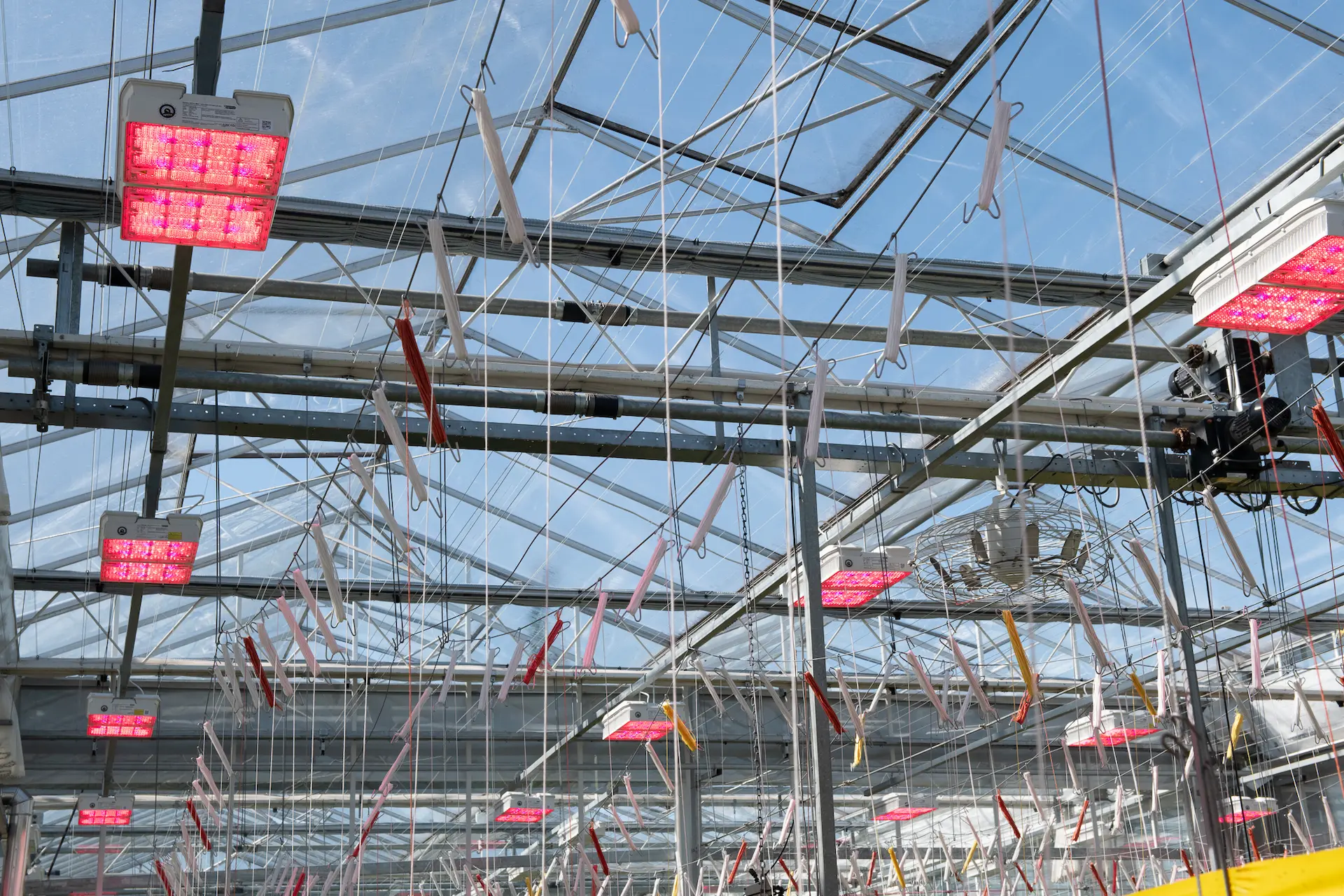
To compare greenhouse lighting systems fairly, start with the crop and how much light it needs. Then compare how efficiently each system turns electricity into light (photosynthetic photon efficacy, in µmol/J), how evenly that light reaches the crop, and what each mole of light costs to produce. The efficacy figure on a datasheet is only the starting point. A reliable comparison also looks at light distribution, controls, heat and total cost of ownership.
The right choice depends on your crop, the amount of daylight, your greenhouse structure and your electricity prices. The sections below explain the key metrics, the main differences between LED and HPS, and a simple way to calculate energy cost per mol.
Which efficiency metrics matter most when comparing grow lights?
Photosynthetic photon efficacy, measured in µmol/J, is the most useful single metric. It shows how many photosynthetically active photons a luminaire emits for each joule of electricity it uses. A higher value means more usable light for the same energy input under the test conditions.
Efficacy alone does not tell the full story, because your crop responds to the light that actually reaches it. When you compare horticultural lighting systems, it helps to look at these figures together:
- PPF (photosynthetic photon flux, µmol/s): the total light output of a luminaire.
- Efficacy (µmol/J): PPF divided by electrical input power.
- PPFD (µmol/m²/s): the light intensity at crop level at one moment.
- DLI (mol/m²/day): the total light your crop receives over 24 hours, including daylight and supplemental light.
PPFD and DLI are different things. PPFD describes light intensity at one moment, while DLI describes the accumulated total across the day. A system can deliver high PPFD for a short period and still reach a lower DLI than a gentler system running for longer. For most crops, DLI is the number that links best to your production plan.
Ask suppliers to state how and where the efficacy was measured. Test conditions, operating temperature and drive current all affect the result, and independent test reports make comparisons easier than marketing figures.
How does LED efficiency compare with HPS in greenhouses?
Modern LED luminaires generally reach higher photon efficacy than HPS, so they often convert electricity into light more efficiently. That does not make LED the right choice in every greenhouse. Heat, light distribution, spectrum, investment and your existing infrastructure all influence the real outcome for your crop.
The main practical differences are these:
- Electrical efficiency: LED usually delivers more photons per joule, which can lower the electricity needed for a given light level, depending on conditions.
- Heat: HPS lamps give off a large share of their energy as radiant heat. In cold climates or seasons, that heat can partly offset heating demand. LED gives off less radiant heat toward the crop, so you may need to adjust your climate strategy.
- Light distribution and spectrum: HPS has a fixed spectrum and a typical light pattern. LED luminaires can be designed with different optics, layouts and spectra, and the best choice varies by crop and growth stage.
- Investment and maintenance: LED typically needs a higher initial investment. HPS has a lower purchase price but needs regular lamp replacement.
- Controls: LED supports smooth dimming, which helps you respond to daylight and energy prices. Not every installation supports every control function, so check compatibility.
If your greenhouse relies on HPS heat in winter, switching to LED changes your heating balance. Include that effect in the comparison instead of looking at electricity use alone.
Why does light distribution change real-world efficiency?
A crop only benefits from photons that reach it at a useful intensity. Uneven light can leave some plants over-lit and others under-lit, and photons lost to walls, gutters or gaps between crop rows reduce the effective efficiency of an installation. A luminaire with excellent µmol/J can still perform poorly if it is mounted at the wrong height or has the wrong optics for your crop.
Uniformity across the crop area
Light uniformity describes how evenly PPFD is spread over the canopy. Poor uniformity may lead to uneven growth and uneven ripening, and it wastes energy in over-lit zones. A lighting plan with a calculated light map shows the expected PPFD at crop level before you invest.
Interaction with daylight and the greenhouse structure
Supplemental light adds to natural daylight, so shading from luminaires matters. Fixture size, mounting height, crop height and greenhouse design all affect how much daylight is blocked and how well light penetrates the canopy. Tall crops such as tomatoes and cucumbers have different needs from propagation or leafy greens. Measuring PPFD in your greenhouse after installation confirms that the real result matches the design.
How do you calculate energy cost per mol of light?
Energy cost per mol is the electricity cost of producing one mole of photosynthetically active photons. Because 1 µmol/J equals 3.6 mol/kWh, the calculation is simple:
- Find the efficacy in µmol/J from a reliable test report.
- Convert it to mol per kWh by multiplying by 3.6.
- Divide your electricity price per kWh by that figure. The result is the energy cost per mol.
For example, a system with an efficacy of 2.5 µmol/J produces 9 mol per kWh (2.5 × 3.6). At an electricity price of €0.10 per kWh, the energy cost is about €0.011 per mol (0.10 ÷ 9). This only illustrates the method and is not a benchmark for any specific system.
This calculation covers electricity only. Your real cost per mol delivered to the crop also depends on uniformity, dimming strategy and the share of light that reaches the canopy. Electricity prices often change by the hour, so a control strategy that moves lighting toward lower-priced periods can change the average cost. Any such shift needs to respect the photoperiod and DLI requirements of your crop.
What else should growers factor into a lighting comparison?
Beyond efficacy and energy cost, compare total cost of ownership, control options, maintenance, heat effects and future flexibility. A lighting system should fit your crop plan, climate strategy and energy contract, not only perform well on a spec sheet.
On cost, compare purchase, installation, electrical upgrades and expected maintenance. Payback depends on your energy prices, operating hours and crop results, so treat any estimate with care. Also look at lamp or component lifetime, warranty terms and how easy it is to get service.
On the technical side, check whether the system dims smoothly, links to your climate computer and responds to daylight, DLI targets and energy prices. Dimming changes light intensity, while dynamic spectrum control changes the mix of wavelengths, so these are separate functions. Confirm that the spectrum suits your crop and growth stage, and assess how the system affects heating and ventilation across the seasons. Modular designs can make it easier to adapt when crops, technology or energy markets change. Retailers increasingly ask growers about energy use, so good efficiency data may also support your sustainability reporting.
Investors and purchasing teams often focus on ROI and total cost of ownership, while growers and technical managers tend to focus on crop performance and daily operation. A good comparison serves both views.
How Agrolux can support your comparison
At Agrolux, we see greenhouse lighting as a project built around your crop, location and existing technology rather than a simple product choice. Our team can help you compare options using measurable criteria, including greenhouse-specific lighting plans that show expected light levels and uniformity at crop level, and light measurements that check the real PPFD distribution in your greenhouse. We offer both LED and HPS solutions, so technologies can be compared under your own conditions, and we can advise on how light levels, DLI and photoperiod relate to your crop and growth stage. For controls, we can support dimming strategies linked to daylight and energy prices. In some cases, modular technology such as LYRA, where reusable structural components may reduce the need to replace complete luminaires when requirements change, can be a good fit.
If you would like to compare lighting systems for your own greenhouse, our specialists are happy to review your crop, current setup and energy situation with you. You can start from the Agrolux homepage or browse examples in our project portfolio, then get in touch to discuss your lighting requirements.
Gerelateerde artikelen
- How can growers balance natural daylight and supplemental lighting?
- What happens when greenhouse crops receive too much light?
- How does greenhouse lighting affect total cost of ownership?
- Red and Blue Light for Greenhouse Crops: Understanding Spectrum and Crop Response
- How does greenhouse lighting interact with heating and ventilation?