


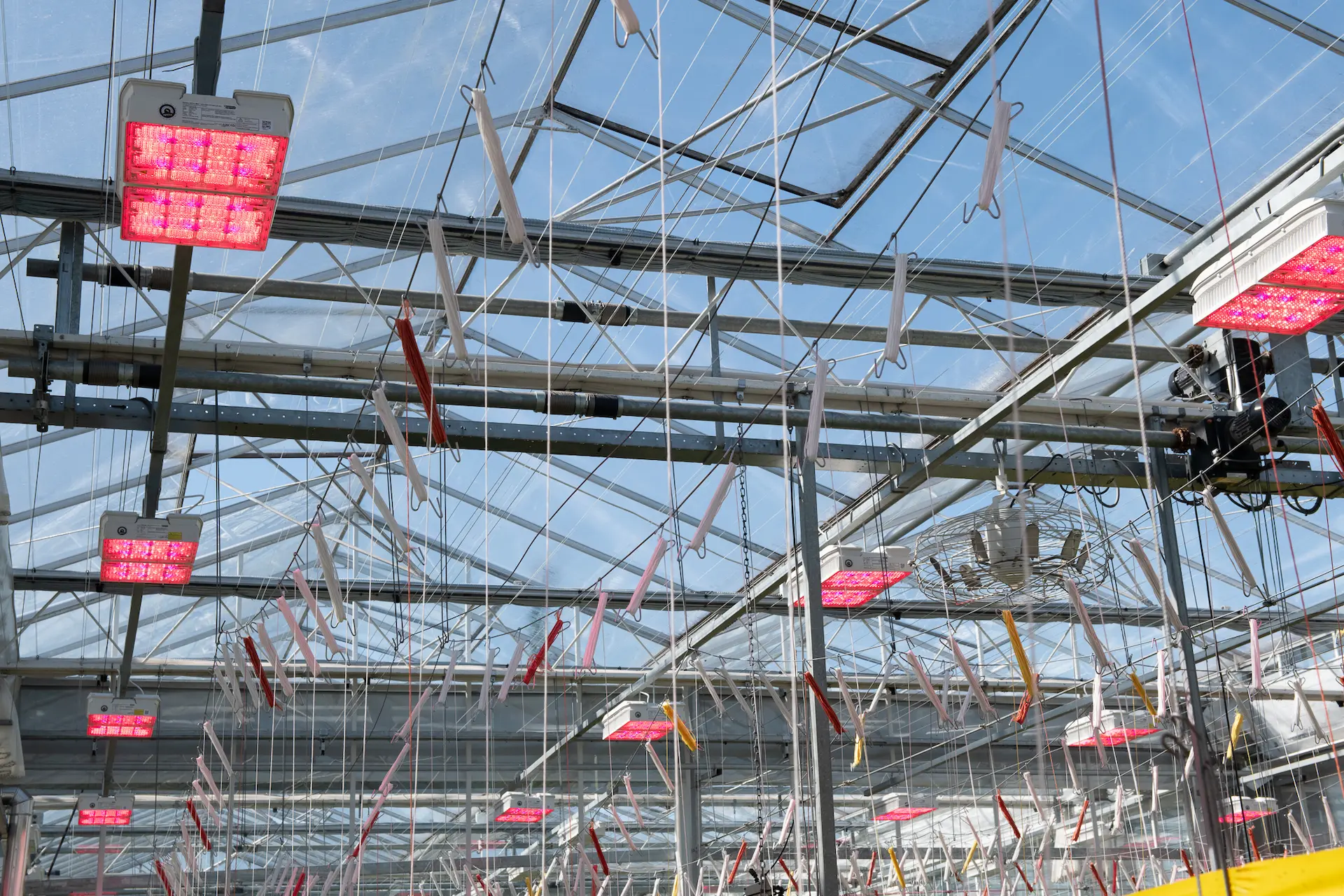
Greenhouse lighting controls measure the light that reaches the greenhouse, compare it with a target, and then dim or switch the lamps to fill the gap. When sunlight rises, the controller lowers the lamp output or turns the lamps off. When sunlight falls, it raises the output again.
How this works in practice depends on your crop, its growth stage, the photoperiod it needs, your control system and your energy conditions. Below, we explain how sensors, controllers, daily light integral (DLI) targets and climate systems work together, and why lights sometimes flicker or overreact.
Which sensors detect daylight changes in a greenhouse?
Daylight changes are usually detected with a quantum sensor, also called a PAR sensor. It measures photosynthetically active radiation (PAR), the part of sunlight that plants use for photosynthesis. An outdoor sensor on the roof records the sunlight arriving at the greenhouse. Indoor sensors measure the light that actually reaches the crop, including the contribution of your lamps.
Most professional setups combine several sensor positions. An outdoor radiation sensor shows how much sunlight is available before the cover, screens and structure reduce it. An indoor sensor at crop level gives a more realistic picture of what the plants receive from daylight and supplemental light together. Multiple indoor sensors help when the greenhouse has different compartments or zones, because light levels vary with orientation, screens, structure and crop height.
It helps to know two terms. PPFD (photosynthetic photon flux density) is the amount of plant-usable light reaching one square metre each second, measured in µmol/m²/s. It shows light intensity at one moment. PAR is the wavelength range, roughly 400 to 700 nm, that plants use. Many controllers also work with radiation in W/m², which a climate computer can use directly or convert.
Sensor quality and placement matter. Dirty sensors, shade from construction elements, and sensors that see too much or too little light all lead to poor control decisions. Regular cleaning and calibration checks help keep the readings reliable.
How does a controller decide when to dim or switch lights?
A controller compares the measured light with a setpoint and adjusts the lamps to close the gap. If daylight is below the target, supplemental lighting switches on or increases. If daylight is above the target, the controller dims the lights or switches them off. This is the core of supplemental lighting control.
The decision usually follows a few steps:
- Read the light: The controller takes the outdoor or indoor sensor value, often averaged over a short period so it does not react to every passing cloud.
- Compare with the target: The target can be a light intensity setpoint, a radiation threshold or an accumulated daily light target.
- Apply boundaries: The system checks the allowed lighting window, the photoperiod and any minimum or maximum output.
- Send the command: The controller switches lamps or sets a dimming level.
The method differs between lighting technologies. HPS lamps typically work with switching and limited dimming steps, while LED fixtures can usually be dimmed more smoothly. With LED dimming, the controller can fill the gap between daylight and the target more precisely instead of switching whole groups on and off. This is one reason LED systems suit dynamic strategies, although the result also depends on the driver, the controller and how the installation is set up.
Keep in mind that dimming changes light intensity, while dynamic spectrum control changes the colour composition of the light. The two are related but different, and not every system supports both.
How do daily light integral targets shape lighting control?
The daily light integral (DLI) is the total amount of light a crop receives over 24 hours, measured in mol/m²/day. With a DLI target, the controller adds lamp light only until that daily total is reached. PPFD, in contrast, describes the light intensity at a single moment.
This matters in daily practice. A bright morning may deliver a large share of the DLI target early, so a controller using a DLI strategy can reduce or stop supplemental light later in the day. On an overcast day, it supplies more light to make up the shortfall.
DLI targets are not universal. They depend on the crop and cultivar, its growth stage, the season and location, the greenhouse construction and cover, and your production goals. A target that suits a young plant in winter may not suit the same crop in a bright spring.
Photoperiod also limits how you can distribute light. Crops have biological requirements for day length and light duration, so light cannot simply be moved to the cheapest hours without considering how the plant responds. Some crops tolerate longer lighting periods well, while others respond poorly to extended or irregular photoperiods.
Where radiation forecasts and electricity prices are available to the control system, a DLI-based strategy can use them to plan when to add light. Depending on your installation, crop requirements and energy market, this may reduce energy cost in some situations. It is a planning tool rather than a guaranteed saving.
How do lighting controls work with climate and energy systems?
Lighting should not be managed in isolation, because lamps add heat and influence transpiration, humidity and crop temperature. The lighting controller and the greenhouse climate computer therefore need to share data and setpoints, so that lighting decisions fit with heating, screening, ventilation and electricity use.
The link between the two can work in several ways. Some installations let the climate computer command the lights directly. Others use a separate lighting controller that exchanges signals with the climate system. The right setup depends on your existing technology and what each system can support.
The interaction matters because lighting changes the greenhouse environment. HPS lamps give off more radiant heat, which can reduce heating demand but may also raise leaf temperature. LED lamps give off less radiant heat, which can change how you manage heating, air circulation and crop temperature. Changes in light and heat affect how much the plants transpire, which in turn influences humidity and ventilation. Opening or closing energy and shade screens changes both the light reaching the crop and the light your sensors measure. Dynamic strategies can also respond to electricity price signals, within the limits set by photoperiod and DLI needs.
For this reason, good light management treats lighting as part of the whole cultivation environment, with the crop as the starting point.
Why do daylight-responsive lights sometimes flicker or overreact?
Daylight-responsive lights usually overreact when the controller responds too quickly to short changes in light, or when the lamps influence the sensor reading. Passing clouds, poor sensor placement and aggressive settings are the most common causes. Visible flicker can also come from driver or dimming compatibility issues.
Common causes of overreaction
If the controller reacts to every short change in light, the lamps ramp up and down constantly in variable weather. Averaging the signal over a period, or adding a delay, smooths the response. Feedback from the lamps is another cause: an indoor sensor that sees the lamp output reacts to its own influence. When the lamps dim, the reading drops, so the controller raises the output again, and the cycle repeats.
Sensor position also plays a role, because shadows from the structure, screens or crop can cause sudden jumps in the measured value. Finally, setpoints with no tolerance band make the system switch back and forth around the limit. A deadband, also called hysteresis, reduces this.
Common causes of visible flicker
The dimming signal, driver and controller need to be compatible. Poor matching can cause unstable output at low dim levels. Wiring problems and unstable communication can also interrupt commands. Dim ramps that are too large or too fast produce sudden changes in output, which the crop and the people working in the greenhouse may notice.
To reduce these problems, check sensor placement and cleanliness first. Then review the averaging time, thresholds and dimming ramps. If problems continue, check the compatibility of the drivers, the controller and the communication setup. Gradual, well-tuned changes help protect both crop stability and equipment.
How Agrolux supports daylight-responsive lighting control
Every greenhouse responds differently to daylight, so we start with your crop and your situation rather than a fixed product choice. We look at your crop, growth stage, location, greenhouse construction, existing technology and energy conditions before we discuss a lighting and control approach.
Where relevant, we can support you with greenhouse-specific lighting plans, light measurements that show how light actually reaches your crop, and agronomic advice on light intensity, duration, DLI and photoperiod for your crop and cultivar. We can discuss both LED and HPS objectively, including heat distribution, investment and operating costs. For dynamic lighting and energy management, we combine software, compatible luminaires, wireless technology and agronomic expertise, within what your system supports.
If you want to improve how your lights respond to daylight, or you see flicker or overreaction in your installation, we are happy to talk it through. You can contact our specialists to discuss your greenhouse, crop and lighting strategy, or look at our portfolio to see how we approach different cultivation situations.
Gerelateerde artikelen
- What Is PPFD and What Does It Tell You About Greenhouse Lighting?
- How can weather forecasts improve greenhouse lighting decisions?
- What should growers consider when upgrading an existing greenhouse lighting system?
- Red and Blue Light for Greenhouse Crops: Understanding Spectrum and Crop Response
- How does dimming affect greenhouse lighting efficiency?